


The Audience and Tech Conference is Dec. 13-16, 2011, and Misnomer Dance is offering a live online performance on Dec. 16, 2011.
Public Policy Through the Eyes of Artists
 In the world of public policy, ideas are a dime a dozen. From issues ranging from education to trade issues, everyone has their opinion about the best course of action the government should take. What’s often missing, however, are new and exciting ways to present these ideas, taking formally bland issues and finding new ways to solve them.
This is where the arts community comes in.
In the world of public policy, ideas are a dime a dozen. From issues ranging from education to trade issues, everyone has their opinion about the best course of action the government should take. What’s often missing, however, are new and exciting ways to present these ideas, taking formally bland issues and finding new ways to solve them.
This is where the arts community comes in.
While city planning and urban development may not be the most exciting issues to talk about, an exhibit in New York City is showcasing four artists who are attempting to use the power of artistic expression to bring attention to urban planning issues that are present in their communities. By offering a unique way of examining these often complicated public policy issues, the hope is that visitors will leave with a heightened sense of the issues that are affecting their community.
The exhibition, “Civic Action: A Vision for Long Island City,” opened on October 13th of this year and continues until April 22, 2012 at the Noguchi Museum and Socrates Sculpture Park in the Long Island City community of Queens, New York. The exhibit has received a fair amount of press attention, including a great write-up in The New York Times last week.
There have been similar art exhibits where policy ideas are presented by artists themselves, who often have no connection to the policy community or stakeholders. What’s unique about this project is that the four artists involved where all invited to partner with an urban planner or architect to imagine and conceive new developments in the Long Island City area, bringing a degree of realism and practicality to the individual projects. Instead of imagining idealistic public spaces or infrastructure improvements, the artists were advised to come up with ideas for spaces that would compliment already existing structures.
The ideas range from practical to the more unrealistic. The four artists featured in the exhibit are Natalie Jeremijenko, Mary Miss, Rirkrit Tiravanija and George Trakas.
Jeremijenko’s exhibit, titled “UP_2_U,” combines the worlds of art and technology (something we love!) and offers some unique ideas of her own. The exhibit includes robots, computer components and more simplistic things as do-it-yourself fixes to become more sustainable. The crux of the exhibit involves asking visitors to take more action to improve the communities around them; as a play off the title, she tells visitors it is “UP 2 U” to bring about the change you’d like to see.
Mary Miss’s exhibit includes a “City as a Laboratory,” where artists, policy makers and stakeholders come together to solve complicated policy problems. Another installation, titled “If Only the City Could Speak,” includes large visual thought bubbles containing ideas and policy ideas for the community. The larger tone of her exhibit invites a sense of participation engagement and encouragement for visitors to get involved in their community. One of the proposals in her exhibit concerns a local issue: four smokestacks that dominate the skyline of the Long Island City community. She proposes to turn the stacks into a kind of environmental sustainability center that creates long-lasting environmental improvements for the area.
My favorite area of the exhibit comes from Tiravanija, who among his proposals includes an idea for a section of Broadway: growing drivable grass. Yes, you read that right. Not all of his ideas are that outside-the-box, however; another favorite is more practical and involves building a community kitchen in the area.
Finally, Trakas’s work involves an area that urban planners and architects around the world have embraced more and more over the years: waterfront development. Naturally, as an artist, Trakas is less concerned with creating stores and condo complexes and stadiums on the waterfront; instead, he envisions a waterfront area as a place where residents can learn more about the community’s history through exhibits and public information. The idea is creating a public space that is less commercial and more about the community itself.
Throughout all four exhibits, the greater message seems to be that the intent is to start a conversation about the future development of the Long Island City area. What types of planning ideas should be implemented? What approaches should local government officials take to complicated public policy questions? While the artists and those involved in the exhibits may not have all the right answers, the exhibit itself is a refreshing reminder that sometimes the best policy ideas do not come from government offices or elected officials: sometimes, the best and most original ideas come from those who are active in their communities, aware of local issues and problems, and passionate enough to devote time to the issues. In this case, that category just so happens to include the arts community.
Tweets and a Show
 The lights dim, the orchestra tunes one final time, and the audience begins to liveblog. Perhaps you’ve heard about operas creating apps or navigating an art museum with your iPhone, but have you considered tweeting during your next trip to the theatre or musical hall? While most venues view cell phones as a rude violation of decorum, others have embraced this modern culture of mobile communication in an effort to enhance the artistic experience. Enter the “Tweet Seat”, as defined by the New York Times section Schott’s Vocab
"Theater seats reserved for Twitter users"
The Milwaukee Chamber Theatre is a notable instance of this phenomenon. During an April production of “The Lion in Winter”, Tweet Seat tickets were sold. Patrons who purchased Tweet Seats stat in the upper-level balcony and were encouraged to tweet during the production. Staff provided a handout with the Milwaukee Chamber’s Twitter handle as well as a special hashtag for their tweets about the show. It should be noted that at the bottom of these instructions was the bolded phrase: “Please silence your phone”. (It should be further noted that no cell phones rang or interrupted the performance.)
Tweet Seats may sound like a fun, edgy experiment to some, but other arts organizations are embracing mobile technologies as a part of their internal culture.
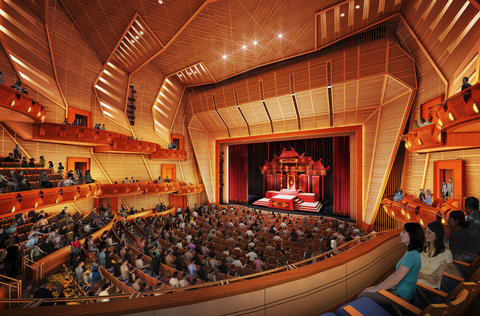
Take a look at the future Tateuchi Center of Bellevue, Washington. When given a choice of blocking cellular service in the building, John Haynes, the CEO of the Tateuchi Center, chose to increase cell phone capabilities in the facility.
Audience members will be encouraged to tweet, liveblog, and interact electronically during performances. The Tateuchi Center is self-described as,
" ...one of the first, great performing arts centers of the 21st century, distinguished by its having been planned not just for a new era, but a new generation..."
What do you think? Is this the natural progression of performing arts? Or does allowing audiences to have their phone out detract from the performance? Is it unfair to the performers?
Would you tweet during a performance?
Social Media Analytics are totally.awe.sm
 Its not often that one comes across a company named awesome. Perhaps, companies fear the mighty implications of cool contained in those two syllables. Yet, one San Francisco based start-up has accepted the challenge of living up to those expectations by putting forth an awe-some value proposition.
“awe.sm is the leading platform for companies to harness social data. We measure how social marketing like Facebook posts and Twitter updates leads to meaningful outcomes, like signups, purchases, and other business goals.”
Its not often that one comes across a company named awesome. Perhaps, companies fear the mighty implications of cool contained in those two syllables. Yet, one San Francisco based start-up has accepted the challenge of living up to those expectations by putting forth an awe-some value proposition.
“awe.sm is the leading platform for companies to harness social data. We measure how social marketing like Facebook posts and Twitter updates leads to meaningful outcomes, like signups, purchases, and other business goals.”
Space
True to their URL address, their work is totally.awe.sm because they are helping developers, marketers, and organizations effectively monitor and measure their social media and marketing campaigns. While awe.sm has been around for the past two and a half years, the company recently made headlines because it received $4 million dollars in funding from the Foundry Group, and it plans to use the money for further development and expansion of its social data monitoring platform.
SPa
Besides its additional services that are tailored towards marketing professionals and developers, awe.sm helps an organization in two ways; through optimizing their sharing and understanding their fans.
Space
Firstly, awe.sm can help further an organization’s social media strategy through individually tracking each post that uses awe.sm’s url shortening code. By tracking each tweet or post individually, an organization can learn about the type of posts that attract web traffic, the optimal time for posts, and the actual monetary returns on social media campaigns. It is this last measure on returns that really differentiates awe.sm from other social media tracking tools because awe.sm lets “publishers analyze just how much a Like is worth to them.”

While Awe.sm’s tracking tools have been Facebook centric in the past, they have recently “evolved to include other social networks like Twitter and developed a more sophisticated set of APIs that allows content publishers more insight into who is Liking and Sharing their posts on Facebook, and who among those converts to paying customers for the content publisher.” Hence, organizations can now use awe.sm to track their posts on Twitter as well as Google+ along with gauging the monetary value of their social media campaigns on each of those sites.
Secondly, awe.sm enables an organization to visualize its social media sharing pattern through some very nifty graphics, which can help an organization identify its influencers, the people who can sway public interest towards a particular product or cause. An example of these graphical and interactive interfaces can be found at VIPLi.st, which is “a fun visualization of the data awe.sm tracks for Plancast.”

While awe.sm is geared towards for-profit organizations, not-for profit organizations can still gain some valuable insight into social media analytics. Awe.sm’s capabilities could be used for fundraising, where organizations could track the kind of posts that are leading to the highest ROIs, shares, signups, and clicks. Moreover, awe.sm would also be very useful in determining which social media channel (Facebook vs Twitter vs Google+) is most effective in connecting and conversing with followers or fans.
And for those interested in learning more about social media analysis, the awe.sm team runs an interesting blog, in which they provide valuable insights into the world of social media along with some great advice on social media strategies, industry predictions, and best practices. Awe.sm also holds webinars for those interested in learning more about the application of their social media platform.
The world has become a sociable place, at least as far as online sharing, liking, and conversing is concerned. And organizations should be careful not to overlook social media analytics because, in essence, they provide insight into people’s emotions, which is a very powerful and influential piece of information for any organization in any field.
Earlier this year, Technology in the Arts wrote a three part series on The Art of Social Media Analytics and with companies such as awe.sm, these analytics truly become an art form because awe.sm’s tools are able to create a compelling and powerful visual story around a set of clicks, retweets, plus ones, and likes.
‘Tis the Season for Getting Those Millennials to Give
With the holidays upon us, Baby Boomers and Generation X'ers selflessly reach deep into their pockets, beyond the lint, to give what they can afford 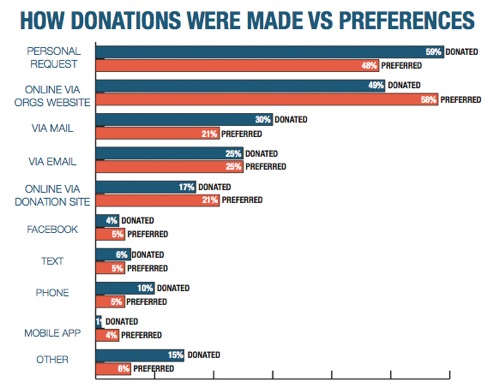 to not-for-profit organizations. But what about the Millennials? How do we get the generation classified in the media and not-for-profit circles as self-absorbed and self-interested to donate? The Case Foundation presents “Millennial Donors Report 2011,” a survey and summary of the motivations and preferences of the Millennials when it comes to making a donation.
Earlier this fall, I posted on the best practices for engaging Millennials, the generation of 20 to 35 year olds that is dramatically affecting the way organizations market their brand and product. So in the true spirit of the holidays, let’s take a look at what may seem like an impossible task: getting the Millennials to donate.
The report surveyed about 3,000 Millennials ranging in age from 20-35 years old. Perhaps the most revealing find of the survey is the following: above all, Millennials value trust. A whopping 90% of Millennial donors surveyed reported they would stop giving to an organization if they had any reason not to trust it. What does this mean for not-for-profits? Build personal relationships with your donors and clearly define where and how the donation is used. Because the Millennials are young professionals, students and young adults with limited funds, they are most concerned their donation of any size will be utilized responsibly. Establishing trust with Millennials will encourage future giving and ensure a long-standing donor-organization relationship.
The report is divided into the categories: giving, giving motivators, special events, communication, volunteering, young professional groups and taking action, as they relate to Millennials. Here is a breakdown of the key findings and the implications for your organization
1. 93% of Millennials gave to not-for-profits in 2010
What this mean for you: Millennials tend to make small donations to multiple organizations, as opposed to the Baby Boomers or Generation X that are loyal to a single organization, gifting large sums of money. They ARE donating, which I am sure comes as a great surprise to the many who tag this generation as plugged-in and tuned-out to the rest of world.
2. An online search using an engine such as Google is the #1 way Millennials get information about a not-for-profit organization
What this means for you: How does your organization appear in a Google search? Millennials often base their decision to donate on the organizations appearance in an online search. Pay attention to your organization’s description on search engines.
3. 57% of Millennial donors gave in response to a personal ask
What this means for you: Though the Millennials seem to inhabit the online space more than their physical space, they are surprisingly more inclined to donate in response to a personal ask. However, that is not reflected in their preferred method of donating- 58% of Millennial donors reported they prefer to make that donation online. An unsuspected dichotomy…
The least preferred methods of the Millennial donors are via mobile applications (4%), the phone (5%) and text message (5%).
Reference the graphic “How donations were made vs preferences” in the report to be sure your organization is providing Millennials with the correct channel for giving that addresses their preferences (the most popular of which are online via your website, email, a donation site, or a personal request). Do not let a Millennial donor slip away by simply neglecting to provide the giving tool that best meets their preferences.
4. 79% of the Millennials surveyed reported having volunteered at least once in 2010
What this means for you: Just as expected of the Millennials, they are strapped for time as young adults and professionals. Thus the resounding reason for not volunteering is lack of time. Millennials are not interested in ongoing volunteer commitments. They prefer one-time, convenient volunteer activities. And obviously, they prefer to volunteer with friends than alone- the ultimate trademark of the Millennials. Of those surveyed, 61% reported they would prefer to volunteer with friends and family as compared to the 44% that indicated they prefer to volunteer on their own.
Get creative with the volunteer opportunities you present to the Millennials. They should be convenient, meaningful, group-friendly and perhaps provide an opportunity for professional development. As we saw when considering how donations are made, Millennials respond favorably to person-to-person contact and requests. Do not hesitate to simply ask Millennials to donate their time. As it turns out, 45% of the respondents reported their reason for not volunteering as never having been asked. So ask away!
5. 85% of Millennial donors are motivated to donate by a compelling and meaningful mission or cause, while only 2% of Millennial donors are motivated by a celebrity endorsement.
What this means for you: We already know Millennials crave meaningful content. They Tweet, re-Tweet and post moving videos, inspiring quotes and stirring news reports. Your website can be a perfect tool for tapping into the Millennials need for meaningful content. Share real-life, specific stories of how a donation supported your cause and not-for-profit. Invite the Millennials to be a part of meetings and discussions regarding the inner-workings of your organization and your strategic plan for the future. Millennials crave meaning, worth and inclusion. Invite them to collaborate with you and they will trust your organization.
The report provides cutting-edge research, insight and practical solutions for attracting and developing relationships Millennial donors. As researchers slowly uncover the hidden truths of these mysterious, influential Millennials and their relationship with the not-for-profit sector, we here at Technology in the Arts will continue to bring you the breaking news!
The Walker, venturing into online magazine style content
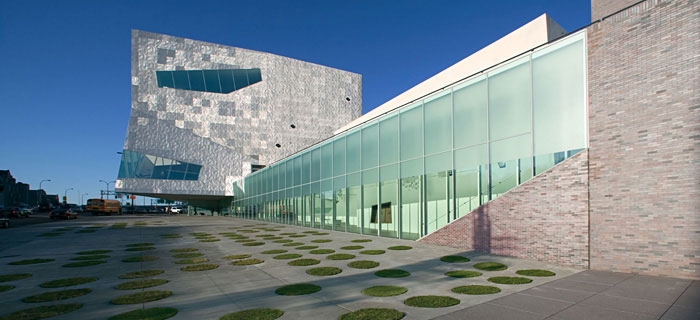 The Walker Center in Minneapolis has a new website that has broken the mold and is venturing into offering content in a way that could help define a new paradigm of online content for large arts organizations. As the executive Director states in her press release: "The intent of the new site is to make visible our role as a generative producer and purveyor of content and broadcast our voice in the landscape of contemporary culture."
By becoming broader purveyors of arts knowledge and information The Walker makes itself more relevant in the broader context of the arts across the country. The expertise that was only available through a visit to a lecture, through a docent on a museum tour, or a talk-back during a performance is now available through the we interface as the Walkers experts are now the gatekeepers for the online content. Thus the reach of the organization becomes multiplied by those people who share content and the organization.
This platform has the potential to lure entirely new audiences through the principle that traffic online follows quality of content. Also by revealing the values of the artistic staff of the organization The Walker is potentially connecting with like minded individuals in the arts community across the world. This in turn could make them into a destination city for arts tourists. By using the multi-disciplinary focus of the institution they are harnessing the the trend but by putting it online they are making it about the global dialogue and making themselves a shining example of what is to come.
A Bear-y Familiar Conversation
Here is a little video to poke fun at the public's all too common misconceptions of not-for-profit arts organizations. After all, Kanye and Bieber do not ask you to make an additional donation for their performances, why on earth do not-for-profits?! Happy Monday to our arts community!
Crowdfunding for the Arts
Crowdfunding and the fund-raising miracles it can achieve is certainly a popular issue. It’s not a new topic for technology in the arts, but it is a constantly evolving topic and worth a revisit. If you’re familiar with the basics, we’ve got some more advanced tips for crowdfunding. This article is meant to aggregate some of the more popular tools out there and help beginners with the basics.
Crowdfunding is usually based on the idea that through micro-donations organizations can achieve goals or projects that they would normally struggle to fund. From that point, all bets are off, as different crowdfunding tools are for different goals. A lot of deciding which tool you will utilize will be based on your organization or its goals. Here are some of the major websites that focus on or include the arts in their projects.
- Basics: We’ve talked about Kickstarter before and it is one of the most popular crowdfunding tools. Users have two months to raise funds and provide rewards to their patrons. Kickstarter’s guidelines specifically state you cannot use Kickstarter to fund a charity - you can, however, use it to fund projects for a non-profit. For example, No-Space of Brooklyn used Kickstarter to fund the move to and costs associated with their forced relocation.
- Pros: Kickstarter has an “all or nothing” platform, if funds are not raised within the 60 day limit, all pledges are dropped. Kickstarter is well known and a fairly safe bet for those looking to fund their first project.
- Cons: The project-centric ideology limits what can be crowdfunded. Also, Kickstarter uses Amazon Payments. While Kickstarter itself does not require those creating projects to be US citizens, Amazon Payments does, which makes Kickstarter out of the reach of international organizations.
- Fees: Kickstarter charges a 5% fee to successful projects. There is also a 3-5% fee associated with credit card transactions on successful projects.
- Basics: USA Projects is another crowdfunding source we’ve discussed before, and it is a project of USA Artists. Potential projects have three months to raise the funds or receive nothing. The Project sponsors “new creative efforts by accomplished artists across the country” and has raised over $1 million so far. All suggested projects are vetted by artistic experts in the related field.
- Pros: USA Projects has a strong institutional background with USA Artists, allowing it to have a gift-matching component, and the average donor gives more than Kickstarter users. All donations are tax-deductible, and artists offer perks for donating.
- Cons: USA Projects only accepts artist members who have previously received a grant or award from their partner and recognized organizations as an individual artist.
- Fees: 19% of all donations go to USA Projects “for use in furthering its general charitable and educational purposes.”
- Basics: IndieGoGo touts itself as “the world’s leading international funding platform”, and is open to “anybody with a great idea”. Projects are not curated. Users have up to 120 days to reach their goal, but unrealized goals still receive the pledged funds.
- Pros: Donations to non-profit organizations on IndieGoGo are tax-deductible, different donor levels have perks related to the campaign. Analytics tools allow campaign managers to track where/who funds are coming from, as well as capture contact information from funders. Anyone can use IndieGoGo for anything, which is has unlimited possibilities. IndieGoGo also has partnerships with non-profit organizations that fiscally sponsor projects.
- Cons: No vetting process on campaigns means your next big, great idea may not carry as much weight for donors as a website where projects are curated. Also the website caters more to individual artists’ projects than arts organizations - arts campaigns are not listed under “Causes” unless they have an educational component.
- Fees: IndieGoGo takes 4% of the money your project manages to raise, if your goal is met. Should your project fall short, IndieGoGo takes a 9% cut of funds raised. International campaigns may have higher fees.
- Basics: RocketHub is a crowdfunding platform for anyone who would like their creative work to be funded, developed or distributed. RocketHub has two levels of fundraising, one is a crowdfunding tool open to anyone. Campaigns have between 15 and 90 days to be funded, unrealized goals will still be funded, but met goals have rewards within RocketHub. The second is called a “LaunchPad Opportunity”, which is a reoccuring vetted submission process. Projects chosen receive an opportunity that will advance their business or campaign beyond simple fundraising (for example, the winner of the LaunchPad Opportunity will work with an expert publicist on generating buzz for their project). A team of judges at RocketHub examines all submissions, and Facebook users vote to help decide which projects to put on the website to fund.
- Pros: Successfully funded campaigns on RocketHub allow the campaign creator to submit 5 entries to their LaunchPad Opportunities without a cost. RocketHub has partnerships with non-profit organizations that fiscally sponsor projects.
- Cons: RocketHub does not have a specific “Art” category, although individual projects could fit well into their other categories.
- Fees: For crowdfunded fees, RocketHub charges 4% of the money you raise if your goal is met. For unfunded projects, the fee is 8%. RocketHub also charges a 4% transaction fees for credit card charges. For first time submitters to a “LaunchPad Opportunity”, there is a submission fee of $8. Those who have a project successfully crowdfunded do not have this fee.
IndieGoGo and RocketHub work outside the states, but there are other crowdfunding tools internationally. There are also tools like Philanthroper, which is a daily deal crowdfunding site for non-profit organizations. There are resources for staying on top of crowdsourcing trends, too. Ultimately, an individual or organization has to consider what type of crowdfunding campaign will work for their needs before deciding on one. If there are any other crowdfunding topics or questions you’d like answered, leave a comment, and we’ll see how we can help.
Limited s[edition]
These past weeks, art newspapers and online publications have been aflood with articles such as “How to buy a Damien Hirst for £7.50” , “Would you spend £500 on pixelated art?”, and “Artists Join the Digital Revolution.” At the center of all this questioning and apparent disbelief is s[edition], possibly an artful manoeuvre of the word sedition, which means an insurrection or a rebellion. Nevertheless, true to the definition of their lexical namesake, s[edition] has decided to rebel against is the centuries old tradition of acquiring tangible art.
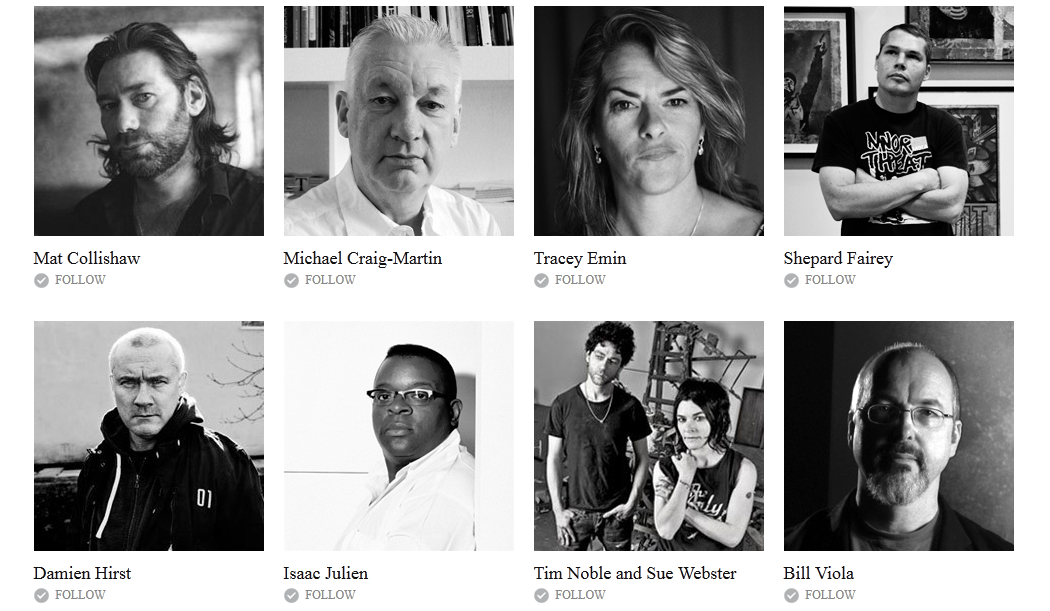
So just how revolutionary is s[edition]? Revolutionary enough to cause some stir, would be the answer of any auctioneer, accompanied with the resounding knock of a hammer. That is because s[edition] is essentially a new online venture that offers digital limited editions of artworks by leading contemporary artists such as Tracey Emin and Damien Hirst, that can be viewed on a host of equally digital mediums such as laptops, iPhones, iPads, or LCD TVs. Moreover, the prices of these limited editions vary from the joyously affordable sum of $12 dollars to the wait a minute price of $800 dollars.
In a sense, s[edition] is making the work of contemporary artists more affordable and accessible but its hard to overcome of a slight feeling of it being digital chicanery because what you see... is what you see. So what one is really paying for is, at times, just the digital image of an artwork. Since s[edition]’s prices are aimed to woo younger generations, are they genuinely encouraging art appreciation and collection or just creating a whole new market to profit from? Chances are, its a combination of the two, leaving s[edition] ambiguously perched among the notions of accessibility and profit maximization.
http://vimeo.com/31910206
While some artworks do seem to lend themselves well to the digital medium, such as Tracey Emin’s I Listen to the Ocean and All I Hear is You or Mat Collishaw’s Whispering Weeds, which incorporate video and audio components, others tend to feel more like a series of static digital reproductions. But then again the price for such editions, like Damien Hirst’s Xylosidase or Bognor Blue, is a mere $12 dollars. The most expensive artwork is a high definition video of Damien Hirst’s bejeweled skull, For Heaven’s Sake, priced at $800 dollars.
With the number of editions ranging from 10,000 to 2,000, should you purchase these digital artworks or more audaciously, make an investment in digital art? Perhaps, because on their website, s[edition] writes, “Once editions are sold out, you can sell your works to other collectors through the s[edition] marketplace launching soon.” So s[edition] is not only looking to create a primary market for digital artwork but also a secondary one. A novel idea indeed, but will it work?
Yes, it could. And it may work solely because, thanks to s[edition], one can now afford to own a Bill Viola or a Shepard Fairey. So even though the Internet is abound with high resolution images of artworks, s[edition] seeks to entice with the covetous concepts of ownership and authenticity. And while the limited editions remain undeniably intangible, one can nevertheless lay claim to a piece of art by a famous contemporary artist. In fact, the innovators and early adopters of the art world are already purchasing these works; some 110 editions of Damien Hirst’s Bognor Blue have already been sold.
However, the early and late majority will only start purchasing these works when they begin to value digital limited editions and become comfortable with paying for what they can only view on luminous digital screens. Then, and only then, will s[edition] truly be able to capitalize on the affordability and accessibility of its business model.
As of now, s[edition] signals a marked step towards the digitization of art, in not only what is represented but the representation itself. Seems like the art world is, after all, responding to the evolution of the touch.
If Facebook were a country, it would be the world’s 4th largest.
So here are a handful of hints, best practices and basic strategies, as compiled from Heather Mansfield’s blog Nonprofit Tech 2.0: A Social  Media Guide for Nonprofits, to maximize the power of Facebook in order to connect with this entire population that is literally, just one click away. Holiday bonus: if you are searching for a special holiday gift for that certain culture vulture or arts manager, consider Mansfield’s recently published how-to guide for not-for-profits titled, Social Media for Social Good. The perfect stocking-stuffer, this comprehensive guide details all the best practices, exemplar not-for-profits and step-by-step instructions (including handy checklists) for building your not-for-profit's online presence and brand- be it a website, an online newsletter, your "Twitter voice," a Flickr account, a YouTube channel, text-to-give technology, tablet applications, etc.
1. Who is the face of your Facebook? Your Facebook page is as good as the social media manager behind it. Creating and maintaining a successful Facebook page (the rewards of which are plenty- Mansfield’s research highlights the direct correlation between the rise of online giving and the rise of social media) depends on the effort and efficiency of the person managing it. Read Mansfield’s blog entry on the 11 qualities of an effective social media manager to be sure your Facebook page is in the best hands possible.
2. Conquer the laggards. Still trying to convince certain skeptical colleagues that this “Facebook thing” is not just a fad? Collect, organize and present to these latecomers the statistics on social media usage (start with a digestible, easy and straight-forward approach, perhaps the video featured above), the trends with rising generations and the shift toward online giving. Still not buying it? Show them what other not-for-profits are doing on Facebook. If you do not join the Facebook community, you are doing your organization a great disservice by becoming less competitive and visible in the not-for-profits sector.
3. You must give some to get some. "Like" other not-for-profit’s on Facebook and engage in activity on their page, with sincerity and moderation of course. Comment on status updates, "like" new posts and respond to news, questions, and comments posted. Not only will you benefit personally from interacting with another not-for-profit and its cause, but by engaging on its wall, you promote your own organization, brand and Facebook page, encouraging Facebook users to explore more about you.
4. Share the love. When updating your own statuses or posting news and comments, be sure to tag any organization you mention (if, and hopefully, they have a Facebook page). This way, your update or post is posted to that organization's wall. Just one more way to put yourself out there…
5. At the bottom of any mass e-mail or automated e-mail response, include a “Like us on Facebook” link to remind your supporters of your presence on Facebook and to give them the opportunity to stayed informed on your progress and activities.
6. Evaluate and adjust. If time after time your posts go “unliked” and your statuses “uncommented,” it is time to consider a different course of action. Facebook is not a newsletter; talk with your followers, not at them. If your Facebook community is not reacting or engaging with the content you publish, evaluate what you are sharing. Is it dead-end content? Does it encourage user feedback? Save the matter-of-fact news for your monthly newsletter and press-releases. Take advantage of Facebook as a community building tool and a platform for exchange.
7. No one likes a Chatty Cathy. Too many status updates and posts per day and that “Hide activity" option on the user's News Feed becomes increasingly attractive.
8. Register for one of Mansfield’s January webinars on successful usage of Facebook and Facebook applications (or check out the other webinars offered on hot topics such as utilizing Google+, YouTube, mobile fundraising, and Twitter).
9. Someone in the office or organization needs a smartphone and needs to be on the mobile web. It does not have to be an iPhone, but in today’s 24/7 streaming news world, it is all about being and staying connected. It is an investment, but one that will be returned as mobile and online giving become the predominant trend.
10. Stay informed. It seems as though Facebook is evolving daily. Do not miss out on the possibilities and potential of the newest features, formats, and most importantly, opportunities for your not-for-profit to expand its reach. Read blogs about the newest changes and innovations in the social media world- a great place to start is right here at Technology in the Arts.
Hope you all had a wonderful holiday!
In An Era of Budget Austerity, Public Art Projects Take on Increased Impact
 One of the unfortunate realities of the current economic climate is that with so many Americans unemployed, and others saving money instead of using it to purchase goods and services, the states, counties and municipalities that rely so heavily on sales tax collections are faced with fewer tax collections and larger annual budget deficits. With most local governments required to balance their budgets every fiscal year, they are forced to cut spending, lay off workers and delay investment on previously planned projects.
Since the 2007 recession, this trend has spread towards nearly every corner of America. As it relates to the arts community, investments in public works of art, like sculptures, statues and murals, have been shelved due to budget cuts. However, at the same time, a rise in grassroots public art projects, funded using online crowdfunding programs, have helped deliver quirky and imaginative works of art to cities nationwide, bringing a small sense of civic pride back to areas devastated by the economic downturn.
One of the unfortunate realities of the current economic climate is that with so many Americans unemployed, and others saving money instead of using it to purchase goods and services, the states, counties and municipalities that rely so heavily on sales tax collections are faced with fewer tax collections and larger annual budget deficits. With most local governments required to balance their budgets every fiscal year, they are forced to cut spending, lay off workers and delay investment on previously planned projects.
Since the 2007 recession, this trend has spread towards nearly every corner of America. As it relates to the arts community, investments in public works of art, like sculptures, statues and murals, have been shelved due to budget cuts. However, at the same time, a rise in grassroots public art projects, funded using online crowdfunding programs, have helped deliver quirky and imaginative works of art to cities nationwide, bringing a small sense of civic pride back to areas devastated by the economic downturn.
We here at Technology in the Arts have previously looked at the crowdfunding website Kickstarter, which serves as a simple way for artists to solicit and accept donations for arts projects from people online. The way the site works is simple: an artist has an idea, he/she sets a fundraising goal that they wish to achieve, and they have three months to reach that dollar amount. The artist will often design a list of rewards for donors to motivate them to donate, and if the project does not reach its fundraising goal by the end of the three month time period, no money is spent and all money is returned.
Kickstarter features projects from many different categories, including theater, music, games and fashion, but its most unique and inspiring pieces come from the world of art, and more specifically, the projects that don’t belong to a gallery or museum, but instead to the people of a particular city. Projects that serve as public goods, ones that all people, from residents to tourists, can enjoy, are the ones I find the most inspiring and important.
Last week, The Atlantic Cities (one of my favorite city/urban policy sites) took a look at six successful and wildly unique public arts projects that have cropped up around the country. These projects, along with the thousands of others featured on Kickstarter, offer a fascinating glimpse into how ordinary people are using the cities around them to express their artistic creativity.
The city of Grand Rapids, Michigan, no stranger to the economic downturn, saw one of the more unique projects I came across: a slew of metal monkeys hanging from a pedestrian bridge near the city’s downtown. The project, titled “Metal Monkey Mania,” successfully completed funding last month.
Across the country, in West Berkeley, California, a set of large ceramic tiles by artist Juana Alicia, designed for a low-income housing complex, were finished, but sitting in boxes because she did not having the funding necessary to install them. Enter Kickstarter, and last week, she reached her goal of raising over $5,000 to finish the project. The beautiful tiles will be hung in the near future.
While not a physical piece of art, one of my favorite public art projects featured on Kickstarter puts everyone who comes across it in the position of artist extraordinaire. Artist Katie O’Beirne has left disposable cameras in New York City and other cities around the world for a few hours at a time, letting regular people who come across the cameras to take pictures of whatever their hearts desire. Taking a look through the images offers a fascinating look into what people choose to show in their contributions. Katie is compiling the pictures and hoping to turn them into an art show in the near future (as of the time of this writing, there is still time to donate to the project and make her dream a reality).
South of the border, in Puebla, Mexico, a group of independent artists have been painting beautiful murals across their city in an effort to celebrate the town’s rich heritage. The group has plans for over two dozen more murals, and has their own Kickstarter page dedicated to bringing more artists to the area that is currently very close to its target of over $29,000.
Nobody will mistake any of these projects as a perfect substitute for a large scale government or privately funded works of art. However, many of the projects featured serve as an inexpensive, quirky way to bring a sense of culture and artistic expression to cities large and small across the country that are grappling with severe budget cuts and austerity measures. And while the economic downturn has forced cities and states to cut back on the kind of 21st century arts projects that many of us in the arts community would love to see, the rise of crowdfunding sites such as Kickstarter and the entrepreneurial spirit of artists everywhere have shown that technology can help bridge the gap until the economy gets back on the right track.
(Photo credit: Colectivo Tomate)
In Case You Missed It - November 2011
 Thanksgiving is coming up, which means a brief hiatus in the posts here. Let’s take a quick look at some of the great posts we had this month, and hear from our bloggers about what they’re thankful for in the realm of technology.
Technology in the Arts took a look at turning digital billboards into art galleries and discussed Facebook and arts organizations in honor of Mark Zuckerberg’s visit to Carnegie Mellon University.
Thanksgiving is coming up, which means a brief hiatus in the posts here. Let’s take a quick look at some of the great posts we had this month, and hear from our bloggers about what they’re thankful for in the realm of technology.
Technology in the Arts took a look at turning digital billboards into art galleries and discussed Facebook and arts organizations in honor of Mark Zuckerberg’s visit to Carnegie Mellon University.
Congress took some time this month to consider a bill to reduce internet regulation, and we discussed how that would impact Net Neutrality.
We also had an amazing guest post by Ashley Paulisick about smartphone apps in art museums, and an interesting piece on how artists are informing the public about pollution. I hope you check out all our wonderful articles from November. Now let’s hear from the Technology in the Arts staff about what they’re grateful for this holiday season –
"I am thankful for ARTStor Digital Library. Nothing makes you appreciate a work of art more than to get up close and personal with the brushstrokes, the pigment, and your computer screen. Zoom in, zoom in, zoom in. Happy Thanksgiving to all our Technology in the Arts Followers!"
"As it pertains to technology, I'm thankful for the three things I can't live without: Google Reader, The New York Times, and HBO. And I can't forget the main things I'm thankful for: my family, my friends, my health, and the chance to learn and work with so many talented people on a daily basis here at Carnegie Mellon."
"Technologically speaking, I'm thankful for a lot of things, but a few stand out simply because they are outstanding:
Google Translate and Google Maps, for without them I'd be lost both physically and linguistically!
Google Art Project for enabling me to see what I never thought I could!
Artfinder and Paddle8 for helping me discover new art and artists no matter where I may be!"
I am thankful for the ever widening world of the arts online. I am thankful that I can now access challenging content through portals like http://www.ontheboards.tv/
I'm grateful that art musuems have embraced modern technology and now let me whip out my cell phone while in the galleries. What once felt taboo now seems encouraged.
I'm thankful for Spotify this year...totally.
That's all folks - have a happy and safe Thanksgiving!
Pollution and Art, Intertwined
 In the world of public policy, change is often quite difficult. Stakeholders are often fearful of abandoning the status quo, reluctant to invest the resources necessary, or ignorant of the need for systemic change. With many economic development issues facing the emerging economies of countries like India, it’s often difficult to make important issues stand out. Sometimes, the most effective way to show the importance of a needed public policy change is through art.
With more and more artists using nature as a way to draw attention to policy issues such as climate change and drought, a group of artists are using the Yamuna River, one of the most polluted rivers in the world, to draw attention to the affect that pollution is having on the environment and the people who count on the river for survival.
In the world of public policy, change is often quite difficult. Stakeholders are often fearful of abandoning the status quo, reluctant to invest the resources necessary, or ignorant of the need for systemic change. With many economic development issues facing the emerging economies of countries like India, it’s often difficult to make important issues stand out. Sometimes, the most effective way to show the importance of a needed public policy change is through art.
With more and more artists using nature as a way to draw attention to policy issues such as climate change and drought, a group of artists are using the Yamuna River, one of the most polluted rivers in the world, to draw attention to the affect that pollution is having on the environment and the people who count on the river for survival.
Located in northern India, the Yamuna is the largest tributary river connected to the Ganges, and serves as the primary water resource for millions of people. There have been numerous attempts over the years to cleanse the river, but to no avail: the Indian government has spent billions of dollars on restoration efforts, an Indian Supreme Court ruling ordered an extensive cleanup, but the river remains severely polluted. The reason for the pollution, many believe, stems from sewage treatment plants that line the river, and the government has done little to impose regulations or shut down plants. With the river currently supplying about 65 percent of the city of New Delhi’s water, this is a significant problem.
This is where the artists come in. Titled Project Y, this public art project is the brainchild of the Ministry of Culture in Hamburg, Germany. As part of the overall 60-year anniversary of diplomatic ties between India and Germany, a series of events, showcases and exhibits are taking place over a 14-month period, and Project Y is one part of that, offering a juxtaposition of two similar rivers under drastically different conditions: the Yamuna, and the Elbe River, located in eastern Germany.
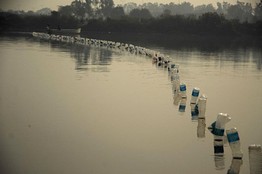
Earlier this month, both exhibits consisted of sculptures, multimedia presentations, and information about the rivers, showing in stark detail the contrasts between the two. At Yamuna, for example, one exhibit showcased rows of dirty plastic bottles as light holders; another simply showed a pig carcass, floating in the river for all to see. One of the technological exhibits of the Yamuna show was a fountain that pumped water from the river, purified it through five levels of filtration technology, and spurted the water in the air above the crowds.
The project also includes screenings of films meant to educate Indians about the Yamuna, and concerts that will be played on the banks of the river itself, featuring artists and performers from both Germany and India.
The idea behind the project is to show how pollution and neglect have left the Yamuna River in a dangerous state, and to raise awareness in the hopes that enough people will see the devastating impact that bad public policy can have on such a crucial part of everyday life. Organizers in Germany are focused on the idea of creating ecologically sustainable rivers in cities and urban areas, and as India grows in size and has to deal with the critical infrastructure and sanitation needs of millions of new people, a look at how governments and citizens in Europe have treated their habitat offers a stark reminder of the challenges ahead.
The co-creator of the project, Ravi Aggarwal, describes the thinking behind the project:
“We need to re-think ecology and rivers in the 21st century where questions about human sustainability and futures have become key. Art is the framework which allows diverse ideas and imaginations to coexist and helps in repositioning ourselves in relation to nature. The river is not ‘polluted’ or ‘clean,’ but is a beautiful landscape of the city, with many layers of aesthetic, social and political meanings.”
Reactions to the project have been mixed. While many have admired the exhibit’s brazenness and honesty, many remain skeptical that such a show can produce the type of change that is needed to purify the river. However, with considerable international media attention focused on the project, it is perhaps sending the right signal to lawmakers and stakeholders that enough is enough, and that the Yamuna, and the dozens of other rivers that make up the Ganges network, are far too important to India’s future to be treated as a dumping ground for sewage and waste.
Much like the intersections of art and technology have brought forth incredible and diverse works of art, it is the intersection of art and public policy that represents an exciting new area of possible change. With so many policy issues present in politics today, it often requires passionate individuals to think of new and exciting ways to raise public awareness. With exhibits like Project Y, one hopes that art can provide the visual nudge needed to start the process of fundamental systemic change.
Green Art, Green Energy
It’s hard to dispute that the United States is in need of more efficient energy solutions, and green energy is an appealing solution. During a November 8th appearance on The Daily Show, former President Bill Clinton predicted solar energy “within five [years] will be competitive in price with coal”. Solar energy undoubtedly has earned the attention of the energy industry, but what about the art world? To recap, solar energy is the energy created by new technologies that converts the energy of light into electricity. This article will focus on the energy created with “solar cells” or “photovoltaic cells”, which are panels that create solar power using the photovoltaic effect.
Which, to be fair, begs the question: If something utilizes solar panel technologies to create energy, therefore has a specific function, can it be art? That’s a high level question that I’m not prepared to get into, so for the sake of this article let us assume architect Louis Sullivan was correct in saying “form ever follows function”.
Upon consideration, it should be quite obvious the form that would be denote the aforementioned function of converting light to electricity: a plant. After all, nature has the best system for converting light into usable energy, why would our own solar-power generating objects assume any other form?

SunFlowers, An Electric Garden as seen at night
SunFlowers, An Electric Garden designed by Mags Harries and Lagos Heder for Austin, Texas answers just that question with 15 giant SunFlower sculptures covering a thousand feet of space along the Interstate 35 Highway. The solar flowers collect energy to power their blue LED lights at night and send the remaining energy to the city’s power grid. At the time of this article, 330,316 kilowatt hours of clean energy have been generated by the sculptures. That’s roughly the equivalent of 10,735 days of electricity usage in an average American house.
If that scale seems a little large, perhaps Darren Saravis’s SolarFlora will appeal to you. These thirteen foot flower sculptures generate solar energy to power its own light as well as outlets at the base of the sculpture that passersby can use for a quick charge. SolarFlora is from the product-development firm Nectar Design, and meant to generate energy from within the heart of a city.
Floralis Generica, open during the day
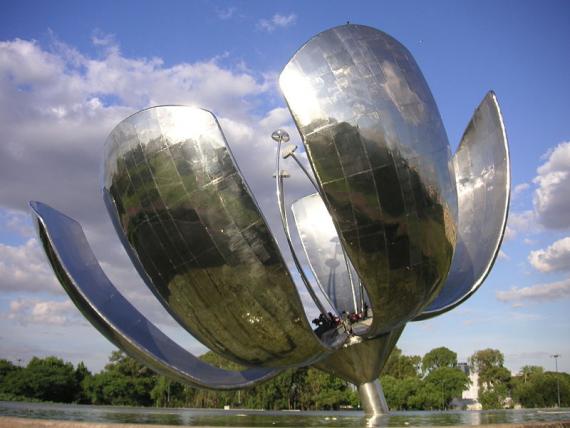
Perhaps the most stunning visualization of this is Floralis Genérica of Buenos Aires, Argentina. Built near the National Museum of Fine Arts, the giant sculpture responds to light and opens its petals during the day and shuts them at night. Four nights a year this stunning piece is lit and remains open after dark. The name, Floralis Genérica, is meant to represent all flowers in the world and its opening daily symbolizes a hope that appears anew each day. All of these solar-powered art pieces personify a future possible with clean energy sources. If creating green energy can be something beautiful, what reasons could we have not to utilize it?
A Visitor's Experience: The Good, the Bad and the Ugly of Smartphone Apps in Art Museums
Having the good fortune of living in Europe for a few years with many of the world’s most beloved fine art institutions in my backyard, I was pleased to test a myriad of their recently launched apps. There is much to be said for the wonderful ways in which mobile devices can enhance the visitor experience. Of course, there are also downfalls attributed to the growing pains associated with mobile. Often I was impressed, entertained, educated, annoyed, and confused – sometimes all simultaneously. Since mobile planning and implementation can be a backend-focused undertaking for museum staff, the following simply offers the perspective of a museum visitor with a smartphone in tow.
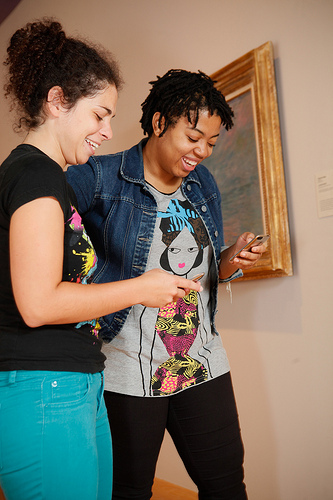
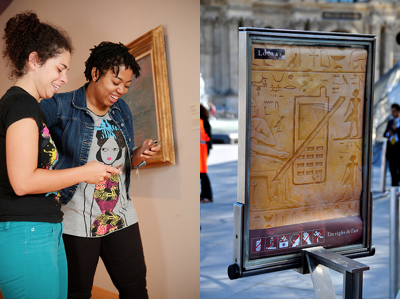 Visitors use a Davis Museum digital art museum guide. Photo credit: Dot Diva.
No cell phone sign at the Louvre. Photo credit: Tom Arthur.
Visitors use a Davis Museum digital art museum guide. Photo credit: Dot Diva.
No cell phone sign at the Louvre. Photo credit: Tom Arthur.
The Good
- BYOD (bring your own device): Mobile devices are increasing all-in-ones for just about everything. Visitors can skip the line for an audio guide because with the same (if not more robust) content available on their own familiar device, they have the distinct advantage of being audio and multimedia guide self-sufficient.
- Deeper connection: With the inclusion of video and other multimedia content, visitors are offered a closer connection to the artists. The Royal Academy of Arts did a wonderful job incorporating video interviews with Academicians in their 2011 Summer Exhibition app. To back it up, a study conducted at the Davis Museum and Cultural Center found that “on average, participants spent about 39 seconds with a work of art when viewing art without the application, and about 3 minutes and 15 seconds viewing art while using the application.”
- Dialogue: Museums are historically notorious for offering one-way authoritative information. Since most museum mobile apps are outfitted with social media tools such as Facebook and Twitter, visitors are afforded a voice to communicate with the museums (and they actually listen).
- Save and share: I still bring my sketchbook with me on museum visits for notes and doodles, but museum apps make archiving and sharing objects of interest easier to come back to when they offer a “favorite this” feature. Other mobile tools such Pinterest and Twitter hashtags also make the impact of a visit more enduring and accessible.
- Off-site relevance: Many museum apps make content valuable off-site as well as during in-person visits. For example, I dashed through Tate Modern’s Miró Exhibition in a rush, but later read about the impact of the Spanish Civil War on Miró’s work via the exhibition app while waiting to board a plane in Pittsburgh. This pared down version of a catalogue is easier to haul around and cheaper.
- “Edutainment”: Why not learn while being entertained? The Andy Warhol Museum’s DIY Pop app is a great example of experiencing both. We have a frustrated museum education staff member to thank for sparking interest in developing a way to digitally educate the public on Warhol’s silkscreen process while replicating it using our own photos.
The Bad and The Ugly
- Connectivity: Yes, a visitor may skip the line for the audio guide, but once in the gallery app download capability may be spotty since many institutions do not offer Wi-Fi (the cost of which can be a prohibitive expense). To make matters worse, the thick walls of many museums can make using a cellular network virtually impossible. If a visitor can access their cellular network, many multimedia rich museums apps can be data gluttons, especially for foreign travelers out of their network area.
- No phone/camera policies: I’ve become a pro at the art of looking like I’m texting someone, when in fact I’m taking prohibited photos and spreading them on Twitter and Facebook. Some museums are finding it difficult to strike a balance between preventing copyright infringement and fully embracing the use of mobile technology. With apps like “Cards,” you can understand the dilemma of wanting to encourage word-of-mouth marketing while not irresponsibly promoting the dissemination of images not in the public domain. But, as a staff member of the Royal Academy of Arts pointed out to me: “If all the 50 people who came through in the last two hours went home to their Facebook and their Flickr, posted photos of this fantastic place with comments, think of the social media publicity. Think of the viral marketing.” Institutions like the RA are well positioned to proactively ask for artists’ permission for visitors to use and spread images of their work online.
- Slow take-up: Tech savvy visitors who would enjoy a mobile option for museum content consumption are likely a little bummed that art museums tend to lag in mobile innovation. It’s hard to blame museums for not leading the way. Shelley Bernstein, chief of technology at the Brooklyn Museum admits on the museum’s blog that: “[W]e don’t have a large audience for our app. In the galleries on any given day...you’ll see very few visitors pulling out smartphones.” There is a significant demographic gap between the typical museum goer and smartphone owner. Yet, since it is predicted that mobile web browsing will outpace Web browsing on desktop computers by 2015, expect to see a jolt of further mobile enthusiasm from museums on the horizon.
Around the Corner
For individuals such as myself, who are certain their value as a human is inextricably tied to the use of a smartphone, 2010–2011 was an especially great time to be wondering the galleries of Tate Britain, Tate Modern, The Royal Academy of Arts, The Louvre, and more. These institutions’ fledgling apps are a solid start to their entree into mobile tech. In the near future, (especially with the help of new culturally focused app developers) I’ll be excited to see the use of image recognition (a copyright nightmare), mobile transactions (e.g. tickets, membership, gift shop purchases), and the further adoption of augmented reality. Am I asking for too much, too soon? After all, I’m about a step away from expecting my iPhone to wash my dishes if I throw it in the sink. Isn’t there an app for that?
Author Bio
Ashley Paulisick completed her master’s degree in Art Business at Sotheby’s Institute of Art in London in 2011. Her dissertation, titled “The Impact of Mobile Technology on Art Institution Visitor Experiences,” took her to some of the world’s most prestigious art museums, including Tate Modern and Pittsburgh’s own Andy Warhol Museum.
Ashley has also worked in arts administration and as a painter under the “pen” name Ashley Cecil. You can read about and see her work at www.ashleycecil.com and find her on Twitter at @ashleycecil.
Paddle8: The Next Generation of Art World Experiences
An exhibition opening at a gallery or a museum is a colorful scene; an installation at odds with gravity, a massive video projection, a performance art piece, some marvelous, some questionable paintings, the bubbling and clinking of glasses, erudition with a tiny bit of pretension. And this very scene is re-enacted almost every week in cities around the world, causing one to wonder if the term ‘well-informed of the contemporary art world’ is becoming ever elusive, for a new exhibition signals yet is a new direction in the fast paced art world of today.
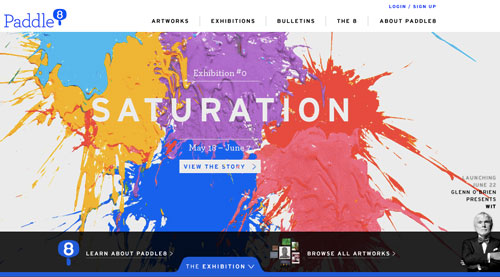
Besides the swooping pace, geography and money are limitations for those who would like to keep abreast with the continual and amazingly relentless evolution of the art world. Perhaps you are one of the privileged few who can jet-set across the globe, going from the Frieze Art Fair in London, to the Biennial in Istanbul, followed by a stop at the Venice Biennale, and a final sojourn at the FIAC Art Fair in Paris (this isn’t a fanciful itinerary, I am merely recounting the travels of Lynn Zelevansky, the Director of the Carnegie Museum of Art).
But considering that a mere 1% hold most of the wealth, chances are, you’re probably missing out on a lot of new and upcoming artists that fall under the categories of the provocative, the obscure, the fascinating, and the truly remarkable. Yes, you can always read hundreds of exhibitions reviews but art, at its core, is experiential and reviews convey the feelings of the writer; you’re own thoughts and feelings bow down to the constraints of geography, money, time, and a tendency to declare that writer knoweth best.
Yet what if there existed certain exhibitions that featured the work of contemporary artists, and were curated by leading figures in the art world, solely for the purpose of online viewing? And, almost simultaneously, I retract the what if because Paddle8, a new online art market venture, is exactly that which I described above :
“Paddle8 is a new destination for examining, understanding, and acquiring unique artworks. Paddle8 is directed towards a generation of collectors, artists, and gallerists who see the web as a viable space for learning and access.”
Since its official launch in June, Paddle8 has hosted an online exhibition every month that features artworks selected by a guest curator. The curator also selects eight “quirky art world influencers” who provide “multifaceted insights on works in each exhibition.”
Every artwork in an exhibition is accompanied by a dossier that offers the viewer a deeper understanding of the artist’s inspirations and motivations. These include video interviews, written explanations of a particular piece, other artists that have inspired the artist at hand, and write-ups on related works that have been exhibited elsewhere. As such, the dossier is both textually and visually rich, with some interactive multimedia experiences that are well suited to an online exhibition format.
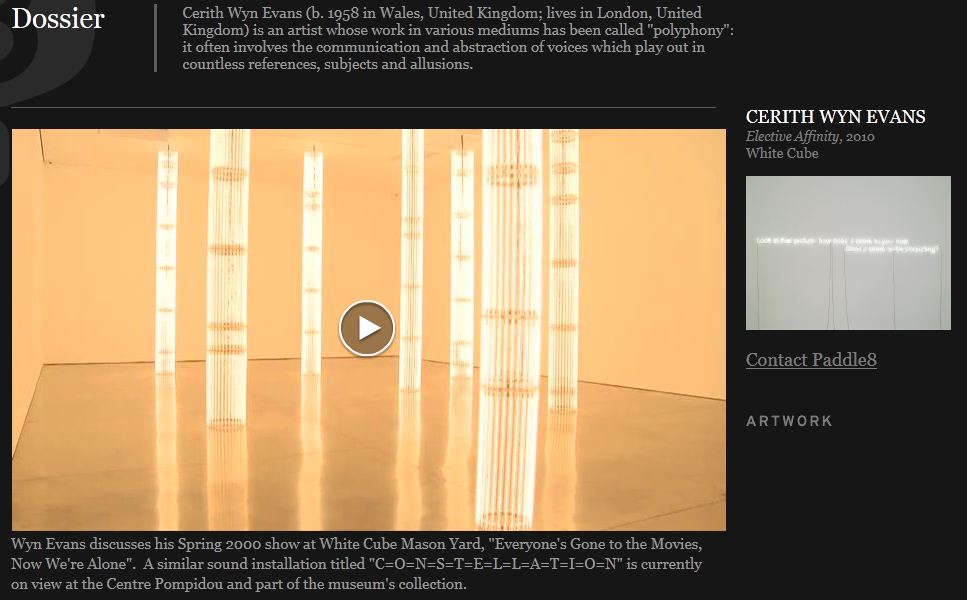
With the aid of the dossier, an entire context is created around a particular artist or artwork, which is often difficult to accomplish in a physical gallery setting. In fact, it is the dossiers, the curators, and the 8 “quirky influencers”, that make Paddle8 a viable alternative to a physical gallery space. Since its launch, Paddle8 has already had four amazing exhibitions, the most recent of which is titled Immaterial, and is curated by the performance artist, Marina Abramović.
So, if you happen to be a collector, Paddle8 is definitely worth a visit or, more aptly, multiple clicks, some of which may set you back by a few thousand dollars or more. If you happen to be a make-belief collector like me, you can still register to gain access to their virtual exhibitions, and one evening, you may find yourself raising a silent toast to the next generation of art world experiences.
The votes are in: the most popular nonprofit cause on Facebook and Twitter is…
Hold on, hold on! Before the grand reveal, a little contextual information. The Nonprofit Quarterly recently published the article, “Which causes do best on social media? That world according to Craig Newmark,” highlighting Newmark’s research on the United S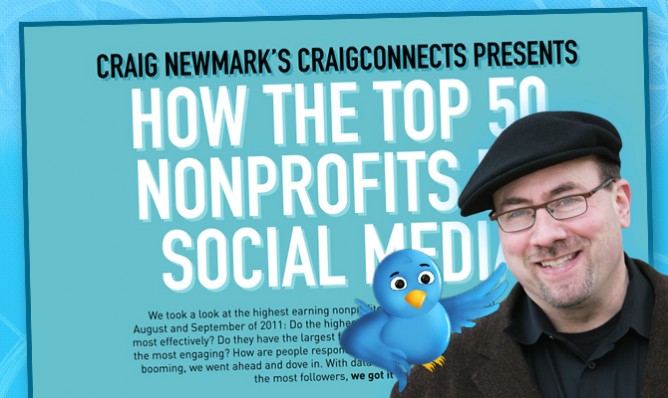 tates’ top 50 not-for-profits (determined by Charity Navigator), their causes and which “do” social media the best. The leading not-for-profit organizations were grouped into categories of causes. Within these categories, the top 5 organizations were analyzed. The categories of causes include:
- Animal
- Children
- Cultural
- Disaster Relief
- Environment
- Health
- Veterans and Military
- Women
To report his findings and analyses, Newmark and his team at Craigconnects produced two cleverly designed infographics, “Who Rules Social Media? A Look at Social Media Impact by Nonprofit Issues" and "How the Top 50 Nonprofits Do Social Media." In addition to data and nifty graphics, the reports shed light on the staffing of these organizations, revealing that of the 21 not-for-profit organizations Newmark and his researchers personally spoke with, all but one employed either a designated full-time or part-time social media staff person. Furthermore, Newmark's research indicates
...revenue does not increase a nonprofit's visibility and interactions in the social media world. Some of the most social media savvy organizations are in the bottom quarter bracket in terms of revenue, yet they are clearly active on social media. It's about fostering conversations and interactions, not money.
The winners of the most talkative category on Facebook and Twitter (in terms of Facebook posts, Tweets and responses) are the animal and environmental causes, averaging between 88-134 Tweets per week; the loser, the veteran and military category. The winner of the most talked about category on Facebook and Twitter was again, the animal cause and the losing causes, women and veterans. Curiously, though women are the dominant demographic using social media, the “women” cause is talked about the least…
How did the cultural cause fare? The top 5 cultural organizations considered in the report were the Smithsonian Institution, the Metropolitan Museum of Art, the New York Public Library, the Metropolitan Opera and the Lincoln Center for the Performing Arts. Averaging 8 Facebook posts and 32 Tweets a week, the cultural cause 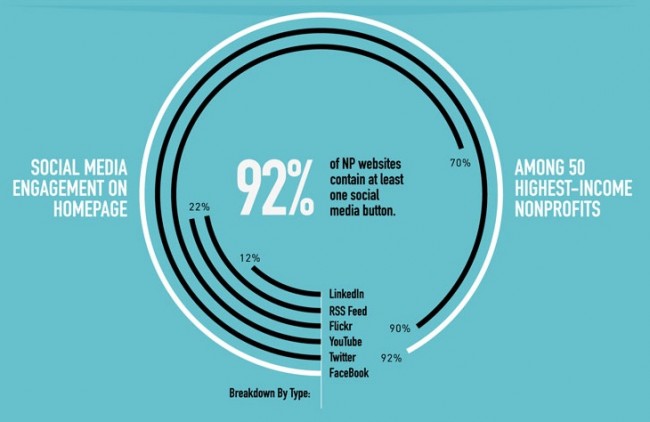 ranked 5th and 4th respectively out of the 8 categories of causes. In terms of being talked about, the cultural cause ranked 5th both on Facebook and Twitter. Comparing revenues relative to social media activity of the top not-for-profit organizations, the Metropolitan Museum of Art ranked highly (considering its reported revenue of $319,054,654 is one of the lowest in the study). While the research and reports do not represent the cultural not-for-profit landscape in its entirety, excluding the hundreds of thousands not-for-profit cultural organizations that did not make the top 50 cut, the message is strong:
… the bottom line is that your main concern should be to cultivate conversations, relationships, and interactions within your own specific community, whether it’s 2,000 or 200,000 people. Work to move “your people” up the ladder of engagement, based on their needs. But know it will take an investment of staff time and resources to achieve this. These are the keys to keeping up in the fast-paced arena of social networks.
Who not only maintains, but stimulates social media activity for your Facebook and Twitter account? Do you have a designated staff person or team regularly producing your online content? If not, can you delegate the responsibility to a committed volunteer or intern? How can not-for-profit arts and cultural organizations make their online social media presence stronger and more impactful to move from 5th place to 1st? With a know-how for attracting and retaining wide audiences in playhouses, galleries, museums, halls, theaters and the like, cultural not-for-profits should have a definite advantage when it comes to the same, but online. Take a look back at your own organizations Facebook and Twitter activity over the last few months, then share your thoughts, solutions and impressions of the research with us on Facebook or Twitter.
Is it time to adopt 3D?

Today 3D cameras that deliver a professional grade product can now be bought for as low as $1,500. Most new TVs sold today are 3D ready. Game consoles and playback devices are also 3D enabled. Is 3D a fad or is it a trend? We can only speculate, but the fact of the matter is that this technology is now becoming affordable for individual artists and arts organizations. So is it time for you to start recording in 3D? Here are some advantages and issues to consider before taking the leap.
Pros:
1) Market penetration is reaching a critical mass. 3D enabled devices now dominate the market and are poised to become a standard feature of home entertainment. 2) The cost of buying 3D enabled devices has gone down. TVs, playback devices (game consoles, dvr devices, etc), and cameras are more affordable than ever. 3) 3D Tech is now making strides into mobile devices with Nintendo, Google, and Motorola notably making devices and content for 3D mobile. 4) The tech offers solutions to art forms that heretofor were previously poorly served by older 2D imaging technology (aka dance and opera)
Cons:
1) 3D on film has been linked to nausea and headaches and even in video there have been questions about eye strain although these problems only seem to afflict a small portion of audience members. Evidently the trick is to not focus on out of focus images on the screen if you suffer from these problems. 2) It will be a couple more years before the majority of TV’s and Mobile devices can run 3D content. As with any technology there is only a point to which it will grow as people are reluctant to buy a 3D enabled HD TV (or playback device) a year after they shelled out for a new HD TV set. 3) There is the possibility that another breakthrough will be made in imaging that will make current imaging technology obsolete. For now, however, the long-term outlook seems to be favoring the current technology’s dominance for the next 6-8 years. 4) You still need those pesky glasses (for now at least).
One could argue that 3D still has a ways to go. The cutting edge of the field however offers the potential for much much more spectacular devices. Now that it is becoming fiscally accessible some artists and organizations have waded in and started experimenting but the potential remains largely untapped. Whatever happens, it will pay to keep a watch on this technology
The Fight over Net Neutrality is Far From Over
Last month, I wrote about what I consider to be the most important public policy issue affecting the arts/technology community, the issue of net neutrality. Since then, a wave of new developments have shifted the playing field and ratcheted up the fight over what is quickly becoming one of the most contentious policy issues in all of Washington. With the new FCC regulations slated to go into effect this Sunday, the legal and political wrangling over the issue is far from over, and the very future of the Internet as we know it is at stake.
First, a quick overview: the issue of net neutrality has received a fair amount of coverage recently because a new set of regulations passed by the Federal Communications Commission (FCC) last December are set to go into effect this Sunday, November 20th. The regulations primarily do three things: they prohibit broadband providers from blocking lawful web traffic; require a greater deal of transparency from broadband providers regarding their network practices; and most importantly, require broadband providers to not discriminate in transmitting lawful network traffic over consumers’ internet service.
arts/technology community, the issue of net neutrality. Since then, a wave of new developments have shifted the playing field and ratcheted up the fight over what is quickly becoming one of the most contentious policy issues in all of Washington. With the new FCC regulations slated to go into effect this Sunday, the legal and political wrangling over the issue is far from over, and the very future of the Internet as we know it is at stake.
First, a quick overview: the issue of net neutrality has received a fair amount of coverage recently because a new set of regulations passed by the Federal Communications Commission (FCC) last December are set to go into effect this Sunday, November 20th. The regulations primarily do three things: they prohibit broadband providers from blocking lawful web traffic; require a greater deal of transparency from broadband providers regarding their network practices; and most importantly, require broadband providers to not discriminate in transmitting lawful network traffic over consumers’ internet service.
While not perfect, these regulations are an important step to ensure that the concept of the “open Internet,” or the idea that all internet traffic is treated equally, continues going forward. Simply, it would preserve open Internet access for consumers, and not allow telecommunications companies to discriminate certain types of data as they see fit.
With the new regulations slated to go into effect shortly, Republicans in Congress have sought to overturn the rules, arguing that they go too far and that new government regulations are not necessary. This past Thursday, the Senate failed to round up the votes necessary to pass a resolution overturning the rules, failing on a party line vote of 52-46, with Democrats voting in the majority to stop the bill from going forward. The Republican-controlled House voted in April on a similar bill, which passed by a vote of 240 to 179.
The opposition in Congress stated that they also believe in the concept of an “open Internet,” but felt that such regulations were better written by Congress themselves and not the FCC.
Supporters of the new regulations, including the FCC, claim that the rules bring a degree of certainty to the internet community. In a statement, the FCC stated that “any effort to disrupt or unsettle that certainty, which has been widely supported by industry, will only undermine innovation and investment in this space.”
Even if the Senate had passed the legislation, President Obama had vowed to veto the bill, ensuring that any legislative efforts to roll back the regulations will fall short of success at least through the 2012 election.
The real immediate fight, however, over the regulations will be fought in court. Several telecommunications companies, most notably Verizon, have pending lawsuits seeking to nullify the regulations, claiming the federal government and the FCC do not have the authority to exercise regulatory power over the Internet. Attempts by the FCC to regulate the internet in the past have failed in the courts, so there is legitimate concern that the current case may meet the same fate.
In addition to concerns over potential content discrimination, there are other areas where telecommunication companies may seek to change their business practices if the regulations do not go into effect. The most common concerns are over higher premiums being charged for faster data speeds, or deliberately slowing down speeds for specific websites or services that may compete with the firm providing the internet access.
As I said last month, the issue of net neutrality impacts all communities, and many of the innovative and inspiring new art works and technologies we have highlighted here on the blog in recent months stand to be impacted if efforts to weaken the regulations are successful. Innovation is best achieved when entrepreneurs, artists and managers have the freedom to use technology to share their art with the world, and the openness of the Internet since its inception has facilitated countless new art forms and inspired a new generation of artists. It would be a shame to see that kind of progress stifled at the hands of Congress or the court system.
After the defeat of the Senate bill, the White House released a statement, saying that “it would be ill-advised to threaten the very foundations of innovation in the Internet economy and the democratic spirit that has made the Internet a force for social progress around the world.” As the fight over net neutrality moves forward and the regulations go into effect on Sunday, it’s important to remember that a free and open Internet is in the absolute best interest of the arts community, and is worth fighting for. That’s a bipartisan belief that everyone in the arts community can appreciate.
13 Social Media Infographics Every Marketer Needs to See
 Happy Friday! What’s everyone doing this weekend? Perhaps you’re saddling up to head to Louisville for the National Arts Marketing Project Conference. The conference starts tomorrow and goes through next Tuesday the 15th – in which case, enjoy the conference! If you can’t make it to Kentucky this weekend, a lot of the conference will be online. Three sessions will be streaming live and archived as webcasts if you miss them. The conference will also be accessible via twitter with hashtag “#nampc”.
The National Arts Marketing Project (NAMP) offers resources year round on their website to help your arts organization be better marketers. One of these is their newest ebook, 13 Social Media Infographics Every Marketer Needs to See.
Happy Friday! What’s everyone doing this weekend? Perhaps you’re saddling up to head to Louisville for the National Arts Marketing Project Conference. The conference starts tomorrow and goes through next Tuesday the 15th – in which case, enjoy the conference! If you can’t make it to Kentucky this weekend, a lot of the conference will be online. Three sessions will be streaming live and archived as webcasts if you miss them. The conference will also be accessible via twitter with hashtag “#nampc”.
The National Arts Marketing Project (NAMP) offers resources year round on their website to help your arts organization be better marketers. One of these is their newest ebook, 13 Social Media Infographics Every Marketer Needs to See.
The first in a series of free publications, 13 Social Media Infographics Every Marketer Needs to See is an accessible and enlightening tool for those interested in social media marketing. The publication covers the history of marketing channels, basic tips for social media usage, and then moves on to more complex topics like the demographics for each social media website. If you're looking for a way to make sense of all the social media out there, this is a great starting point.
Technology in the Arts also has a lot of great social media resources, including how to analyze your success, tap into that prized demographic, and important current trends. How is your organization using social media to be better marketers?