
GlacierWorks: A Detailed Look at Climate Change

The glaciers are melting’ is a phrase that we have heard and read, in all its literary permutations and combinations, ad infinitum. And the term “ad infinitum” should raise concern among us because when certain phrases are repeated so often, when they are so widespread, the world becomes inured to them. Ironically, despite of the size and scale of most glaciers, many of us have probably never encountered these sublime bodies of ice. So when we hear about the plight of our glaciers, we shrug and give a slight brrr of concern, for we are not acclimated to contemplate the cold beyonds of planet earth.

But what if we could visualize our glaciers at different points in time? What if we could see how much they have changed over the past century? Would we finally comprehend the glacial magnitude and urgency of climate change? GlacierWorks certainly thinks so.

“GlacierWorks is a non-profit organization that uses art, science, and adventure to raise public awareness about the consequences of climate change in the Greater Himalaya. By comparing our modern high-resolution imagery with archival photographs taken over the past century, we seek to highlight glacial loss and the potential for a greatly diminished water supply throughout Asia.”

The GlacierWorks team, which is led by “filmmaker, mountaineer, and adventurer”, David Breashears, re-traces the photographic and mountainous footprints of early 19th and 20th century photographers, each of whom dared to explore the Himalayan terrain during the course of their lives.

Among these early pioneers is the famous 19th century Italian mountaineer and photographer, Vittorio Sella, who is best known for his breathtaking images of the mountainous landscapes in Europe, Asia, Africa, and America. Whilst in India, Sella took a series of “awe-inspiring images of the Jannu and Kangchenjunga Glaciers, as well as the Karakoram’s Lower Baltoro Glacier.”

Another eminent photographer, whose images are traced by GlacierWorks, is Sir Edward Oliver Wheeler who was the Surveyor-General of British India from 1941 to 1947, and was knighted as a result of his notable work  in topography for the Indian subcontinent. Other noteworthy photographers of Mount Everest and its surrounding terrain include German filmmaker, Norman Günter Dyhrenfurth, and  George Herbert Leigh Mallory, who was a member of the 1921 British Reconnaissance Expedition, which “explored routes on Mount Everest and produced the first accurate maps of the region.”

In order to provide us with a compelling difference between the masses of our glaciers today as opposed to just a century ago, the GlacierWorks team determines the photographic point or location from where each of the images by Vittorio Sella or Sir Edward Oliver Wheeler were taken. As such, we are able to make a glance-by-glance comparison of the Himalayan glaciers through two images taken from the exact location, but with a century’s worth of time in between them. This visual comparison is sublime, even melancholic, but the overarching message is grim, for these images provide us with the cold, icy truth about our glaciers; not only are they melting, but they are doing so at a devastatingly alarming rate.  
On their website, we are encouraged to do some virtual mountaineering of our own so that  we may become familiar with the majestic but eternally distant Himalayan glaciers. In collaboration with xRex studio, “a visual effects practice which explores the intersection of high-end computer graphics and advances in digital photography”, GlacierWorks has created incredible 180 and 360 degree immersive explorations that re-create the awesome entirety of the Himalayan landscape, all in gigapixel imagery.

And with the use of gigapixel imagery, GlacierWorks has accomplished an uncanny yet astonishing feat: they have placed before our very eyes, the detailed truth on glacial loss; and they have made us confront, the absolute reality about the future our glaciers. GlacierWorks’ photographs incite a sense of loss and the necessity to change our profligate ways, before all that remains is a set of high resolution imagery, before the comparison between the glaciers of the past and those of the present is beyond discernment.

The 2011 UN Climate Change Conference will take place in Durban later this month. Here’s hoping they agree on at least a few environmental measures because inconclusive climate summits is something we have heard and read about ad infinitum.
 

Deconstructing, Reconstructing and Tidying Up Art

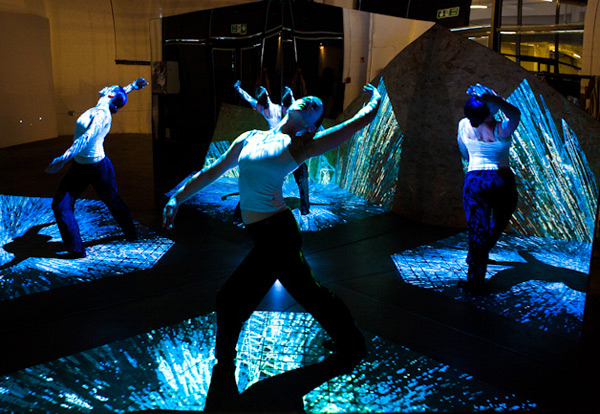
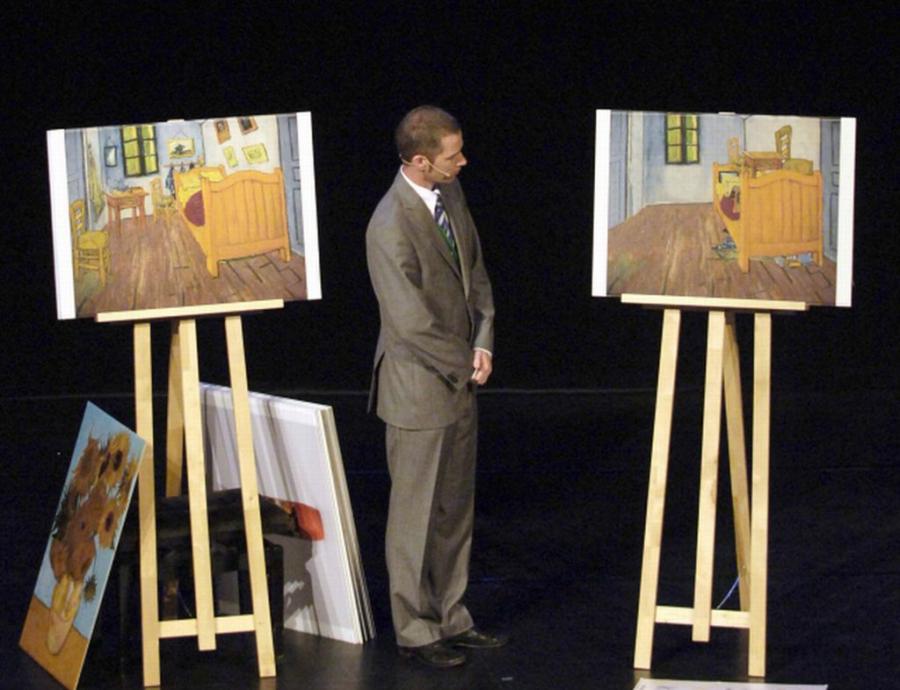
In this Wednesday's post, exhibit viewers re-choreograph Henri Matisse’s Dance II and a Swiss comedian cleans the floor of Vincent van Goh’s Vincent’s Room, Arles. Yes, you read that correctly, what I have to share today is as glorious and odd as it sounds. It has taken me quite some time to settle down long enough to write this post- I have been rather distracted by these projects and videos. I know you will be too…sorry in advance… Let’s first take a look at Intel’s newest project in its Visual Life campaign- “Remastered: A Visually Smart Production from Intel.” Showcasing the work of leading curators and innovative designers, the exhibit on display at London’s One Marylebone explores and pushes the boundaries between art and technology; more specifically, between “old art” and Intel’s newest processing technology. The result, you ask? A sound installation remake of Wassily Kandinsky’s On White II, an online application of Pablo Picasso’s Guernica, a moving image rendering of Salvador Dali’s The Persistence of Memory, a food design and photography adaptation of Leonardo Da Vinci’s The Last Supper, a visual animation of J.M.W. Turner’s Rain, Steam and Speed-The Great Northern Railway, and a stereoscopic, and 3D animation of Casper David Friedrich’s Wanderer Above the Sea of Fog (a special favorite of mine), just to name a few. Collaborating with jotta, Intel’s curatorial and creative partner, the artists “remastered” select classic works of the world’s greatest masters using digital processes to give new meaning to “old art” for a modern audience.

…The exhibition unlocks the creative potential of technology and underlines how visual masterpieces can be created with simply a mouse as a brushstroke or a screen as a canvas.

Exhibitions like these generate much discussion in both the academic and professional art world, as the issue of the digitization of art remains a hot topic of debate. What is most inspiring about these remastered pieces is the beauty in the medium. As an art history student and Italian Renaissance aficionado, I am neither offended nor resistant to the digital world’s claim it can reproduce or master painterly qualities and techniques in its own medium. It is important to view these “remastered” pieces not as competitors of the original work, but as showcases of the power, potential and influence technology has in the modern artistic process.

If you are familiar with Turner’s oeuvre, be sure to view Eric Schockmel’s 3D animation of the painting, Rain, Stream and Speed- The Great Northern Railway. Known for his unsurpassed ability to render light, Turner’s work is an experience of the Sublime, an aesthetic theory originating in the 18th-century. Schockmel’s stunning remastering addresses themes consistent in Turner’s work. But can the advanced technology of 3D modeling, animation software, Adobe After Effects and sound design create an experience of the Sublime, a theory developed in response to a level of advanced and dramatic painterly techniques? Or is it unfair to project such standards and theories on the entirely unique and individual medium of digital art? Do we need to develop a new vocabulary with which to discuss it? The artists featured have contextualized the meanings of the “old art” in today’s modern and digital age. As jotta's head of creative, Ben James stated

The broad range of work and outcomes exhibited within Remastered help demonstrate how technology is being adopted practically and conceptually by artists and designers across all disciplines. The intersection of technology and art has gone far beyond its creation on a computer to a symbiotic relationship -- one where new technology offers new opportunities to the artist or designer who, in return, provides ever-evolving experiences and contexts to our relationship with technology.

If nothing else, each artist’s unique interpretation of the work makes viewing the remastered piece and accompanying videos a worthwhile activity on this midweek, midday Wednesday (Bompas & Parr’s redesign of Da Vinci’s The Last Supper is a good place to begin, it will surely amaze you).tidy up art

Ok, on to my next obsession. Have you heard of Ursus Wehrli? No? It’s okay. I had not either before viewing his TED Talk. Since then, however, I am either always a) re-watching his talk or b) mentally rearranging and reorganizing the components and forms of any given painting into tidy stacks. My new guilty pleasure is the TED Talk “Ursus Wehrli tidies up art” given by Wehrli, a Swiss comedian, cabaret artist and

…the author of Tidying Up Art, a visionary manifesto that yearns toward a more rational, more organized and cleaner form of modern art. In deconstructing the work of Paul Klee, Jasper Johns and other masters into its component parts, organized by color and size, Wehrli posits a more perfect art world

Take your Wednesday lunch break with Wehrli as he taps into your confusions and Type A tendencies when it comes to viewing and understanding contemporary art. The talk will surely elicit laughter; proceed with caution when at work.

And again, my apologies for any drastic drop in productivity at work or school as a result of time spent transfixed by the digitally remastered masterpieces or watching, and re-watching, Wehrli’s convincing contemporary art cleaning spree.


The Arts and the Race Against the Machine

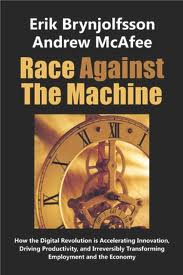
Will art ever be created by a machine? This is the question that is sometimes asked, late at night over a glass of wine. Perhaps it has been already. Authors Erik Brynjolfsson and and Andrew McAfee ask similar questions and explore the answers in their new book “Race Against the Machine: How the Digital Revolution is Accelerating.” Machines are playing an increasingly prevalent role in the work force and millions of jobs have been changed or replaced by computers or automated process. There is now a program called Stats Monkey that is being used to write about sports. Stats Monkey uses pattern recognition to generate summaries about sporting events. Although this program does not seem to be in usage by any major publication, it highlights the progress that has been made in the advancement of technology and the subsequent replacement of millions of workers by automated, computer controlled devices. For now, the arts world can sigh with relief. It seems as though most endeavors which require intuition are safe from encroachment by computerized processes. We can assume that artists of all stripes are considered “high-skilled” and are intuitive in the creation process.  Both of these characteristics make artists of all stripes the safest categories of workers at this point in time. The pursuit of making art isn’t simple. Artists of all kinds exist within a complex cultural context and react intuitively to it. This context also makes it extremely difficult for machines to interact. You could argue that Heather Knight’s Silicon Based Comedy is the first inroad on this front, but it still seems a bit far away. The complex human interactions intrinsic in the performing arts are a distant land from the world of automated tasks and promise to remain that way for quite some time.

Another barrier to program or automaton generation of art in all forms is the fact that there is a plethora of artists who are working in the market for little or no money.   From the standpoint of economics the lack of money in the majority of the arts field gives developers little reason to make inroads artistic process by replacing people with automation. Aside from the rockstar phenomena in the arts world, there simply isn’t the money in it to make it worth the time.

As technology speeds along we can be assured that these advancements will affect the arts. Already kickstarter promises to reshape the field of development in the arts by cutting out the administrative middleman and connecting artists directly to funders. Will increasingly sophisticated templates and design programs begin to make inroads into graphic design? Will marketing in social media be able to be automated? Will marketing in general be able to be automated. Certain facilities tasks are already being monitored by computers. Vacuuming lobby or gallery floors could be taken over by a fleet of roomba robots.

How will the future of technology manifest in the arts world? Surely at some point in time it is conceivable that a computer will generate a work of art and sell to some museum. This will inevitably make the news. This will spark controversy. Will actors be replaced through cgi? Well, the clear answer to that is not yet. Stage actors are even safer from replacement, but how about stage crews?

It is impossible to discern how exactly machines will interact with the arts. Watching the development of cutting edge technologies can gives clues. Possibilities to interact with our patrons lie largely untapped in the areas of 3d, holography, and new software applications. As with other industries, it is incumbent on artists to watch the horizon and harness technology as it comes into being, otherwise we end up being reactive and being blind-sided by change.

Facebook in the Arts: In Honor of Mark Zuckerberg's Visit to CMU

With the announcement that Facebook founder and CEO Mark Zuckerberg will make his first visit to Carnegie Mellon University (CMU) today, the Technology In the Arts team thought it would be appropriate to take a look back on the groundbreaking social media platform and the impact it’s had on how arts organizations engage their audiences. CMU is one of three campuses being visited by Zuckerberg during an East Coast college tour. While here, he will meet with faculty and students and give a talk to an invitation-only audience. He will be joined by Mike Schroepfer, Facebook's vice president of engineering.

Here’s a bit of Facebook Trivia to get us started:

  • More than 800 million active users
  • More than 50% of active users log on to Facebook in any given day
  • Average user is connected to 80 community pages, groups and events
  • More than 350 million active users currently access Facebook through their mobile devices
  • Facebook is also the most popular social network for all age demographics according to a Forrester Research Survey

One of the most interesting studies on how Facebook has affected arts and cultural organizations was conducted this past summer. ‘The Tangled Web of Social Media’ was a study commissioned by Theatre Bay Area in 2011. The study examined the social media habits of 207 diverse nonprofit arts and cultural organizations with the goal of understanding how social media was being used and what best practices emerged as a result. The study found that Facebook was by far the most popular social network used by these arts organizations. Another similar finding was that community members were eight times more active commenting on the Facebook posts made by arts organizations than mentioning those same organizations on Twitter.

Here are a few ways in which Facebook has revolutionized how arts organizations are engaging with audiences:

  1. Sharing Content: Arguably one of the most important ways Facebook has impacted arts organizations is the ability to share and distribute content. Devon Smith recently shared an important comment made by Adam Connor from Facebook during the High Impact Social Media Conference: History of the internet= Browse (Yahoo) –> Search (Google) –> Discover (Facebook). Whether it’s a special Halloween photo from MOMA or a series of intriguing videos from the San Francisco Ballet, arts organizations have the opportunity to share a variety of content with audiences.
  2. Giving Campaigns: Facebook has also impacted the way audiences can contribute financially to their favorite organizations. The Chronicle of Philanthropy recently published an article about a California boy, Paddy O’Brien, whose inspirational story about his struggle with bone cancer resulted in 1,000 donations to the Children’s Hospital who treated him via the Facebook Causes platform.
  3. Advertisement Campaigns: Facebook Ad Campaigns aren’t just for boosting numbers on fan or group pages. Many organizations have had success with attracting new fans to their events through successful ad campaigns. For further reference, Tech In The Arts published an article on best practices for running ad campaigns.
  4. Ticket Buying: Companies like TicketForce have made it possible for many artists and organizations to sell tickets directly through their brand’s Facebook Page. The client operates so that ticket buyers do not have to leave the Facebook Page in order to purchase tickets.
  5. Merchandise Sales: Facebook has also provided the opportunity for artists and organizations to sell merchandise on their pages.
  6. Building Communities through Facebook Groups: Many arts organizations have also been experimenting with hosting group pages as opposed to “regular” pages. Groups can provide an opportunity for fans to interact with each other on a more intimate level. Beth Kanter recently featured a guest post on her blog regarding best practices for nonprofits interested in building a group page.

There’s no doubt that this social media giant has had an incredible impact on the way arts organizations interact with audiences and will continue to do so. Ultimately, many of these organizations are finding creative ways to interact with existing fans and build new audiences in a manner that has never been done before.

How has Facebook impacted your organization, either positively or negatively?

Art Viewed Through the Prism of 3D Technology

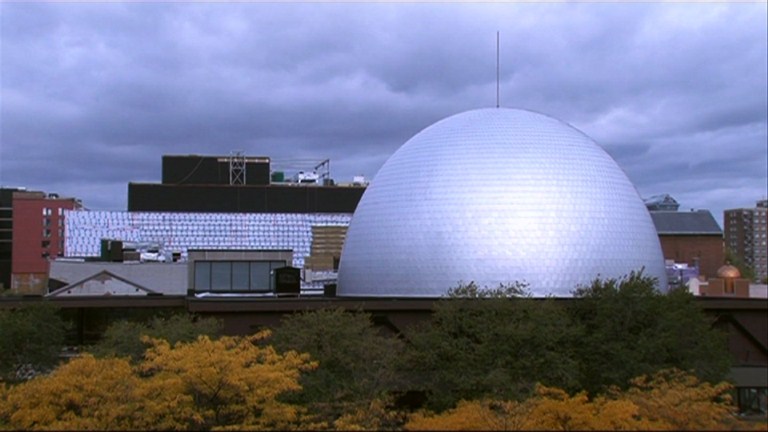
On a typical trip to the American film multiplex these days, you are instantly greeted with the latest 3D films the studios have dreamed up. A market once reserved for the likes of advanced science fiction pictures, the technology has been stretched to now include nearly every major release. Given this barrage of often mediocre films, one would be hard-pressed to not grow tired of a technology still in its relative infancy. 3D technology, however, is not just limited to feature films. In Montreal, a cinema has embraced 3D technology and is using it to provide its audiences with floor-to-ceiling views, advanced speaker systems and a 360-degree view of stunning works of art.

The Satosphere theatre, as reported by AFP, is housed inside a giant silver dome in the city of Montreal, and is offering its audiences a unique way to enjoy the arts. The technology behind the cinema is impressive: measuring 18 meters in diameter, the dome has eight video projectors that display images all along the walls, encircling viewers and creating a truly immersive environment. Along with the projectors, the theatre also includes over 150 speakers, creating a truly cinematic experience.

And the best part of the experience? No bulky 3D glasses are required to enjoy the show.

AFP recently offered a behind the scenes look at the theatre, which you can view here.

The first show to display the technology, “Interior” by Marie-Claude Paulin and Martin Kusch, took place last month and wowed audiences both visually and sensually. With many more performances planned in the months and years ahead, the technology affords artists a new kind of opportunity not yet seen before.

The possibilities here are endless. Imagine an art show where attendees can become part of the experience, interacting with other attendees in a virtual exhibit. Or imagine being lifted to another time period or environment, surrounded by a 360-degree image of an architectural monument, barren deserts or idyllic beaches.

In addition to the opportunities for the arts community, other fields are also taking a look at the technology and seeking ways to possibly integrate it into their industries as well. Developers, hospitals, architects and many others are imagining ways to use 360-degree views to transform the way government officials, tenants, patients and more view planned projects or improvements, offering a way for people to experience a drawing or rendering in a visually immersive way before something is built.

The researchers behind the technology have no plans to just stop at immersive and interactive art shows. One of their current projects is developing a six-lens camera that uses software to merge images together, creating a seamless way to film 360-degree films.

The people behind the theatre are calling the experience “cinema for the 21st century” and “a playground for the next century,” and I’m inclined to agree. As it relates to the arts community, I can only imagine the countless creative ways and uses for a technology such as this; if the technology becomes inexpensive enough to spread worldwide, it’s quite possible it could usher in an entirely new era of artistic expression.

So the next time you leave the movie theater, disappointed with the “3D” technology in films like “Harold and Kumar” or “Puss in Boots,” remember that there are far more innovative uses for the technology being embraced all over the world, often at a significantly higher quality, perhaps headed our way very soon.

The Evolution of Touch

In the 15th century, the Italian renaissance polymath, Leon Battista Alberti, wrote a famous treatise on painting titled De pictura. In his treatise, Alberti praised painting above other art forms such as sculpture because painting often went beyond the act of mere imitation and was able to create an illusion that could persevere through the centuries. Moreover, the art of painting was a uniquely visual experience and, unlike sculpture, it did not incite the desire to touch, for what we saw in a painting remained poetically out of our reach. This treatise postulated by Alberti during the period of the Renaissance is not entirely archaic and arcane to the world of today. We still take pleasure in the transitory ability to escape into the painted world we see before us, and we are in still in favor of preserving the the illusion we see before us. But have we become drawn to what was only considered possible in the realm of sculpture, the desire to touch a painting?

This question of touch is a thought provoking one because of a recent phenomenon that I like to refer to as the “slide to unlock”. Yes, this phenomenon is none other than our increasing desire to avail ourselves of the sense of touch. Apple has gently nudged us along into the wonderful world of touch through iPhones, iPads, and iPods. So, it suffices to say that in the technological realm, we have effectively and decisively entered into the era of the sensory. And this definitive entry into the realm of the sensory has led to the development of apps, some of which have enabled us to explore the world of art at our very fingertips.

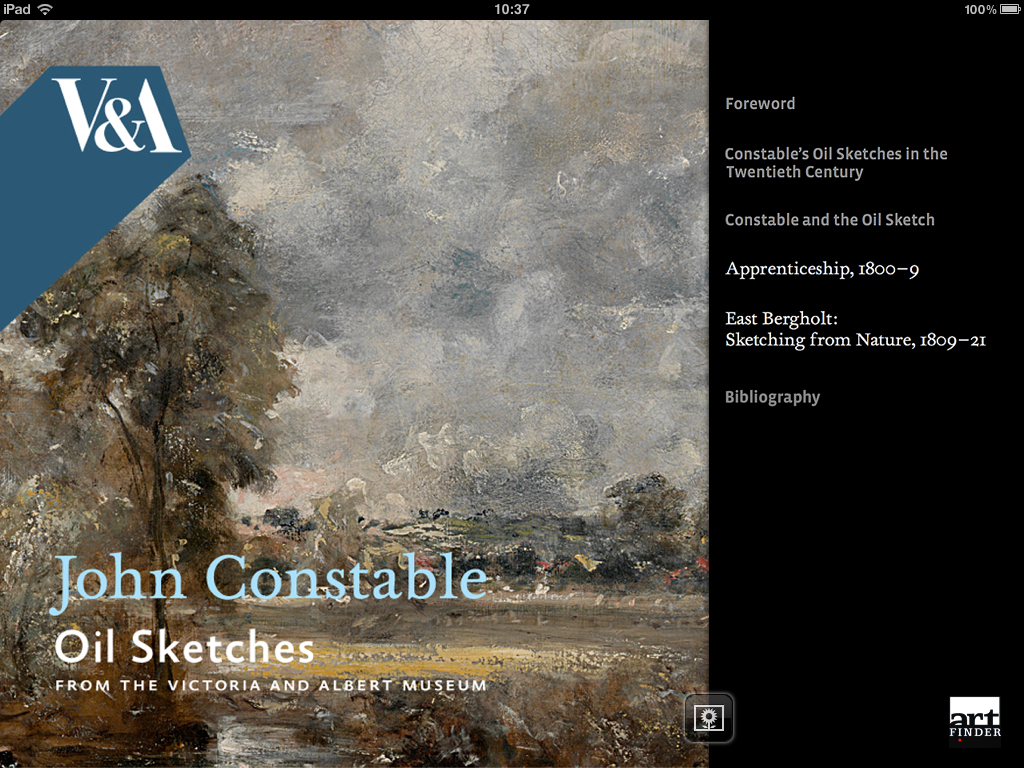
Nowadays, we can explore artworks using our sense of touch without compromising our moral integrity or damaging the artwork, and shattering the illusion before us. For instance, in Artfinder’s app on John Constable’s oil sketches from the Victoria and Albert Museum, we “can zoom to show each of the sketches in their incredible painterly detail, and follow Constable’s progress from Suffolk, to London and Brighton.” Artfinder has also collaborated with various other museums to create apps that augment and physically sensitize the viewing experience. As such, the way we engage with art may be undergoing a paradigm shift; a shift towards the touch.

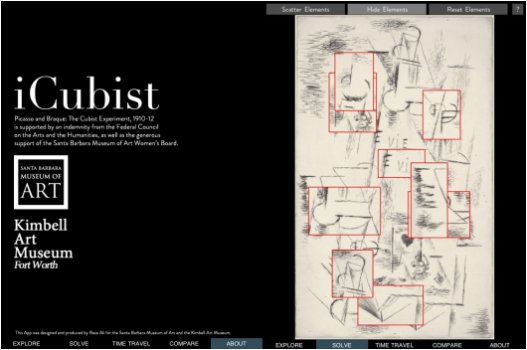
Consequently, more and more museums are now incorporating the sense of touch into what was hitherto seen as predominantly visual and contemplative experience. Earlier this summer, in the exhibition titled “Picasso and Braque: The Cubist Experiment, 1910-1912”, the Santa Barbara Museum of Art provided visitors with iPads that were “equipped with a specially developed iCubist application to scrutinize and delve deeply into four key paintings.” The app also allowed visitors to “deconstruct a cubist composition and attempt to put it back together.” The iCubist app developed for the Santa Barbara Museum of Art demonstrates how the sense of touch, in unison with the sense of sight, can help demystify a movement such as Cubism.

It is also interesting to note how the contemporary art world is evolving with the rise of the touch. For instance, artist David Hockney began painting on his iPhone in 2008 and last year he began using his iPad to create art. Using the Brushes app, Hockney would draw flowers, using just the edge of his thumb, and send them to his friends.  His oeuvre now includes landscapes, still life, and self-portraits all created by a sweeping touch, rather than a stroke, of creativity and ingenuity. Currently, his work is being shown at the Royal Ontario Museum in the exhibition titled “David Hockney’s Fresh Flowers: Drawings on the iPhone and iPad.

So is the art world moving in tandem with the technological world? Is it stepping into the realm of the sensory?

As artists such as David Hockney remain a rare few, the art of painting on tangible mediums such as canvas will most likely survive decades of technological progress. The modern day audience, however, may be more willing and receptive toward the introduction of touch into the viewing experience. This is because, as an audience, we may be drawn towards what can only be termed as a two-part deception; to make tactile, what in reality is untouchable, while reveling in a scene that in essence, is a grand illusion.


Roadside Digital Galleries: Coming to a City Near You

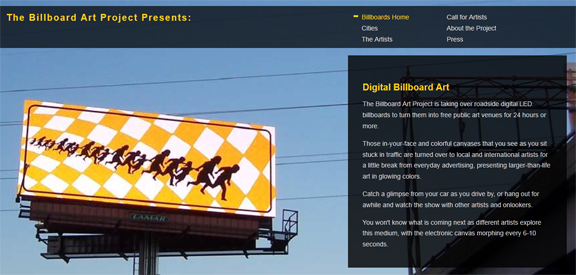
billboardEvery some-odd miles along the highway you zoom past a billboard for Dunkin Donuts seasonal coffees; the local hospital’s most recent, national ranking; a sexy, sleek couple drinking Jose Cuervo and a dramatic advertisement for what can only be described as a less-than-credible attorney. Firms and organizations seek to capitalize on the exposure a billboard provides their brand or service in its commanding position above and along the highway. Hoping to attract potential consumers or clients, the billboard is one of the most prominent and far-reaching means of advertising to a certain geographic location. From the morning commute to the bus ride home, and every moment between, we are inundated with advertisements in one form or another. Though the constant stream of advertisements is admittedly annoying, advertising powers our economy, encourages consumerism and inspires us to try new products and attend performances. But commute after commute, the billboards and their advertisements littered along the highway become nothing more than white noise.

The Billboard Art Project, a Virginia based not-for-profit, is temporarily reclaiming a handful of digital LED billboards in select cities across the country. Repurposing the advertising billboard as an artistic medium and a public art venue, the Billboard Art Project is marketing a different, non-commercial message

Those in-your-face and colorful canvases that you see as you sit stuck in traffic are turned over to local and international artists for a little break from everyday advertising, presenting larger-than-life art in glowing colors…You won't know what is coming next as different artists explore this medium, with the electronic canvas morphing every 6-10 seconds.

While out driving, Billboard Art Project creator David Morrison, was moved by the soothing images displayed during a screen test for one of Lamar Advertising’s (a Louisiana based advertising firm) digital LED billboards. The scrolling images were void of logos, brands, and slogans- images for images’ sake, if you will. In a domain that is typically reserved for corporations, commercial advertising and profit-driven marketing, Morrison found the images refreshing, even humanizing. Deviating from social expectations for exhibiting art and of the function of a billboard, the Billboard Art Project repurposes digital billboards to breathe new life into the daily commute- the epitome of the mundane and the expected, of the everyday and the routine.

The Billboard Art Project launched in October 2010 after Morrison successfully negotiated with Lamar Advertising for use of one of the company’s digital LED screens for 24 hours. Thanks to the digital technology of the billboard, the project promises 24 hours of a continuous stream of vibrant images, without interruption or advertisements. In an open call to doctors; cab drivers; students; clerks; professors; military personnel; hospital workers; the unemployed; designers; mail carriers; New Englanders; Pittsburghers; Texans- anyone- the Billboard Art Project invites submissions to be considered for each show. It is an all-inclusive project in which everyone is invited to participate by either submitting a work or simply driving past it. The medium becomes the message as the digital billboard disseminates art and individuality.

The project is currently showing in New Orleans, with previous exhibits in Chicago, IL; Reading, PA; Duluth, MN; Savannah, GA, Nashville, TN and Richmond, VA. Up next, the Billboard Art Project heads to Baton Rouge, LA then San Bernardino, CA. Each submission is as unique to the individual creator as the final compilation is to the city and billboard. No two shows are alike.

Bringing art to the streets in a free, public and conveniently located show, the Billboard Art Project is challenging the traditional domain for both advertising and displaying art. But is this new manifestation, the roadside digital gallery, a viable venue for art? Let us know what you think. In the meantime, keep one eye on the road and one on the lookout for a roadside electronic gallery, coming to a city near you.

Building online community: sketchcrawl.com

Seven years ago Enrico Casarosa, an artist working for Pixar went on a pubcrawl. He writes that the spirit of community inspired him to create a community for visual artists that he called Sketchcrawl. The first Sketchcrawl happened in 2004 in over 20 locations in six countires. Since then, there have been 33 Sketchcrawls and the event has grown to almost a hundred locations in over 20 counties and now has a website sketchcrawl.com.  The community now has over 3000 members and is still growing.  At first, only Enrico was moderating, but Sketchcrawl has since grown to have numerous other worldwide administrators organizing participation and the community has strong leadership in both Asia and Europe as well as in North America.

A Sketchcrawl is a day predetermined thoughout the world, where artists young and old, professional and amateur pledge to sketch for anywhere from 20 minutes to 8 hours.  The results of the event day are posted online for the whole worldwide community to see.  There are  some true gems in these online galleries. Participants speak of both the reward and difficulty of committing to draw for an entire day.  They recount the lucidity that comes from a full day of observation and moving from subject to subject.  They also comment on the difficulty of focusing their attention for so long. Side by side, these artists are creating a community through a shared experience and their love of art. Alongside their peers the collection of images lead us through a sense of movement throughout the day and objects and people that once were ignored as mundane become visible and interesting.

This community, built through a mutual love of the arts, is a strong sign of the growth of the arts online and should give the arts community at large hope for the future in the face of declines elsewhere.  The next Sketchcrawl is on January 21, 2012.  It is easy to sign up and there are also multiple social network sites for the community at large and for individual city groups.

In Case You Missed It - October 2011

The leaves have fallen down and the air has begun to crack with cold – October is ending! Here’s a look back at some of the big topics our we tackled this month. Not only does Technology in the Arts recognize the need to protect federal funding for the arts, we also took a look at how artists can protect themselves and their digital intellectual properties.

From there, we took a look at how the arts and business can cohabitate peacefully with the BMW Guggenheim lab.

We gave everyone some insight about into up-and-coming demographic, The Millennials, and how your organization can reach them.

Of course, all work and no play makes this a boring blog. We discussed how arts organizations can utilize a game dynamic, as well as took a closer look at the mobile app game integrated into the experience of the Tate Modern.

We had loads of great articles this month, and I hope you take some time to check out them all. Enjoy the weekend and have a fun and safe Halloween!


Crowdsourcing Creativity

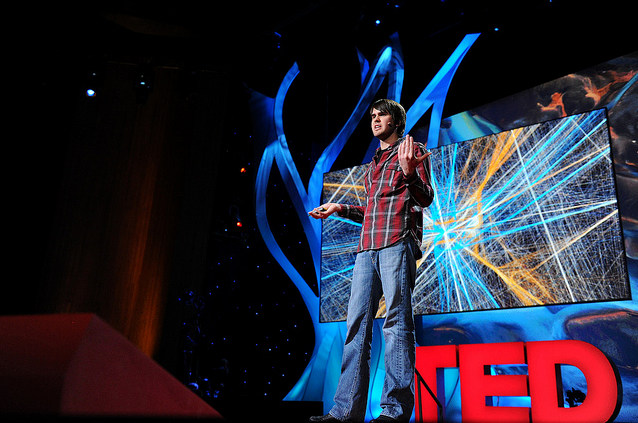
At a TED talk earlier this year, Aaron Koblin, an artist “specializing in data and digital technologies”, began his talk by drawing attention to a tweet from a media theorist: “19th century culture was defined by the novel, 20th century culture by cinema, the culture of the 21st century will be defined by the interface.”
I need this blank space
Now let’s deter ourselves from contemplating how we live in a world where tweets have become the new medium for philosophic aphorisms. Instead, let’s contemplate the interface, which means “a common boundary or interconnection between systems, equipment, concepts, or human beings.” Some thoughtful seconds later we can begin to comprehend the importance of the interface and how it has provided the world with numerous platforms for communication, the most important of them being the Internet.
Space
 need this blank space
And this overwhelming ability to interact and communicate has given rise to another interesting phenomenon; crowdsourcing. Essentially, crowdsourcing is a means of relegating a specific problem or a task to members of the public and it provides access to something that was virtually impossible in the pre-Internet, pre-interface era; the collective brainpower of the wired world.
I need space
So what does a digital artist like Aaron Koblin create in the era of the interface? How does Koblin proceed when it dawns on him that he can explore the creative processes of the online world? He proceeds by surrendering his own paintbrush and easel but providing a whole host of individuals electronic canvases, paints, and paintbrushes; Koblin crowdsourced his art, he crowdsourced creativity.
Space
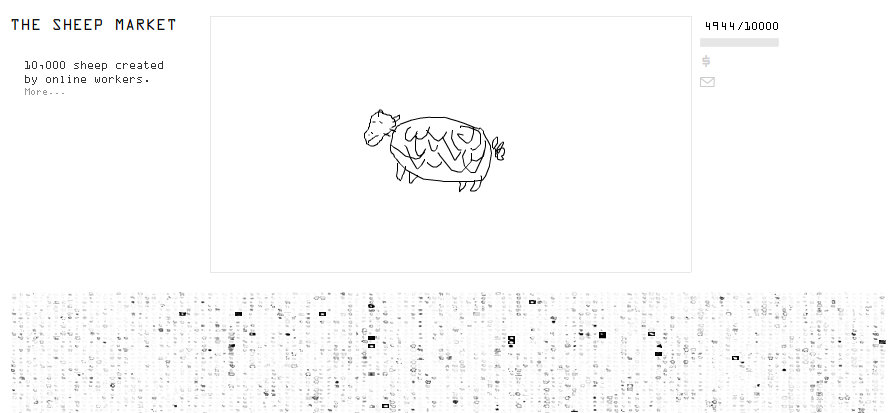
More specifically, he used the crowdsourcing capabilities provided by Amazon’s Mechanical Turk to create art. For his first project, Koblin created a drawing tool and paid people 2 cents to draw a sheep facing the left. And thus he began collecting sheep, drawings and drawings of sheep, 10,000 sheep. At the end of the project, he created a website called thesheepmarket.com, where he sold a block of 20 sheep as a “one-of-a-kind plate block of lick-able adhesive stamps.”
Space
pace
And technologically acute, brilliant artists, such Koblin do not crowdsource just once, they crowdsource again, and again. Some of his other incredible projects are Ten Thousand Cents and a Bicycle Built for Two Thousand, both of which demonstrate the extent and power of human collaboration made possible today, notwithstanding the lack of context and monetary gain.
Space
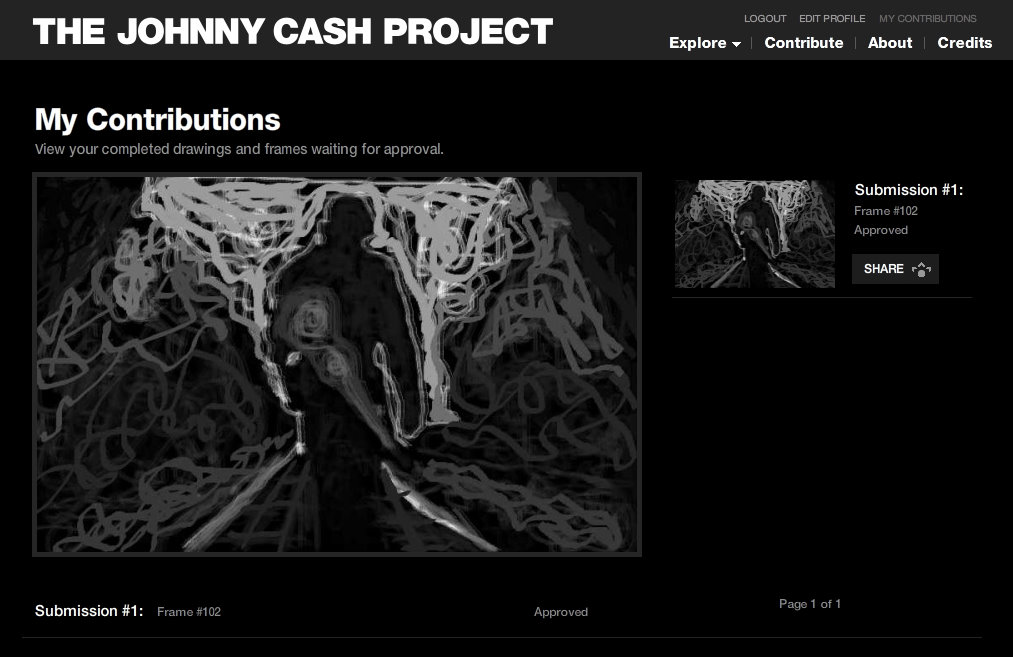
The most recent of his pursuits is The Johnny Cash Project; “ a global collective art project”,  where people from around the world can contribute to making the music video for the song, Ain't No Grave, which was Cash’s final studio recording. In collaboration with a host of people, archival footage of Johnny Cash was used to create a video for Ain't No Grave, which was then cut into several different frames. More specifically, the footage was cut into eight frames per second, leaving people with an ample number of frames for, albeit mouse-driven, creative expression.
Space
pace
As such, anyone anywhere in the world, could, and still can, re-create and render a frame from the footage using the drawing tools provided to them on the website. All of these frames become inter-weaved and form a final video homage to the great Johnny Cash that is cohesive yet disjointed, anonymous yet personal.
Space
Crowdsourcing, of course, is not limited to the field of artistic creation, for it can spark, even set ablaze, inspiration and innovation in almost any field.  Earlier this year, we read about how an entire opera production was crowdsourced! And ever since, the phenomena has only led to more sighs of delight, awe, and more recently, exclamations of eureka!
Space
The concept behind fold.it, a website where users “solve puzzles for science”, is none other than that of crowdsourcing. An article in the Smithsonian magazine takes note of some of the other organizations that have used crowdsourcing; NASA, Harvard researchers, and the European Space Agency. Yet another article in the Washington Post mentions how the Dead Sea Scrolls project by Google opens the door for “amateur detectives to seek clues that elude scholarly academics.”
Space
Even museums can no longer hide, not even behind their impressive forest of columns in the Ionic order, from the phenomenon that is crowdsourcing. The Concord Museum in Boston recently celebrated its 125th anniversary with the exhibition titled  “Crowdsourcing a Collection”, which was “curated by 25 selected individuals drawn from literary, arts, or political circles.
Space
For arts organizations, crowdsourcing is a innovative way to engage, communicate, interact, and participate with your audience. So when faced with a vexing problem or task, why defer from asking the wired world to aid and guide you? If you were waiting for a call from the savvy technological beyond, here it is; crowdsource creativity, crowdsource innovation.

What Makes Me, innovation from Down Under.

There’s a project going on in Australia that is the largest online digital storytelling project in the country. The project invites people to tell stories about what has made the arts special to them and how they’ve been touched by the arts. They tell their stories through audio, video and writing. The cool thing about it is, anyone in Australia can do it.  As of today, it has several thousand entries. The project was launched in July of 2010 and the results are aggregated into a into a giant, growing testimonial page with search-able contents by genre.

This website is called “What Makes Me”. There are three different sections: What Makes Me, What Makes You, What Makes Us. Each person claims a cube, a cleverly designed multimedia enabled object online and they decorate it with their images, video, and audio files.  Each one is very different. The first twelve entries talk about why each individual loves a certain art form or forms - whether it be dance, circus arts, graffiti or something else.  All of them are touching and told from the heart.  There’s a retired nurse that found out her next door neighbor was a circus performer and has since fallen in love with the circus. There’s a professional rugby driver who drives around looking at the graffiti all over the city. There’s a professional cook who while catering a party, discovered dance for the first time and has since developed a personal relationship with the choreographer.

The common thread that runs between most of these testimonials is the personal connection built with a specific artist or the arts in their neighborhood. It’s about relationships, rather than facilities, and community as the key to these relationships.

The idea around this project was to counteract the perception that the arts in Australia are “associated with images of snobbery and inaccessibility”.   The project is run by a company called Wanted Digital and initiated by the Australia Council for the Arts.  The participants of What Makes Me are cooperating to build something together- it’s a game.  A game that is getting the attention of philanthropic organizations in the US.  Wolf Brown recently used this interactive project as an example of participation in the arts in their recent study commissioned by the Jame Irvine Foundation “Getting In On the Act - How arts groups are getting opportunities for active participation”.

What Makes Me is worth taking a second look at. The project engenders enthusiasm that isn’t created from simply being a spectator.  Anyone in Australia can be a part of it and there is a hefty presence on the site from diverse populations with Aboriginal people, the disabled, and immigrant communities being well represented. Participants post links to their cube, to their facebook, to their twitter, to other social media sites. The individual act of creation combined with the community have a ground swell effect and foster even deeper love for individual artists and the arts contributions to the community.

Art Meets Technology in New York City

For many of us in the arts community, especially in cities that feature a wide variety of art opportunities to explore, we are often tasked with a dilemma: what is the best way to find not only events that are close to me, but also events that my friends and I will enjoy the most? As is often the case, this is where technology comes in. The New York Times reported yesterday on a group of young arts professionals in New York City who are using social media to not only find those very events that are the most appealing to them, but also to organize like-minded individuals to join them at the newest buzz-worthy art gallery opening or museum exhibit. The tools and tactics these arts professionals are using can serve as an excellent model for artists and art lovers in any city where the arts are appreciated.

For those who are looking for more targeted art opportunities, there are a number of social media outlets where you can discover more information. The first is Meetup.com, a website where millions of people have created and found scheduled events in their communities. A good section of the site to bookmark is museums.meetup.com, where you will find dozens of groups and thousands of members all across the country who meet regularly and advertise upcoming arts events. For example, here in Pittsburgh one of the many great arts groups is the Pittsburgh Cultural Arts Group, home to 550 members who organize regular arts-related events and shows.

Organizing events and participating in MeetUp activities is not only a great way to find out about upcoming shows; it also serves as a place to meet fellow arts lovers and make contacts in the arts community. Especially for those young people who are either in school or new to a particular city, MeetUp can serve as a conduit to meeting others who share their unique interests. Instead of attending that upcoming exhibit you were looking forward to alone, you know have the opportunity to share the experience with people who share your passion and interests.

So meeting and befriending fellow arts lovers is the first step. Once you have found a group of people committed to discovering the latest and hottest events, what’s next? Instead of using more general platforms like Facebook or even text messages, the young professionals profiled in the NYT piece and many others have used Twitter to share news and events not only with their friends, but with the entire world as well. They use the hashtag #artstech to promote events, share tips and/or links to more information. The great thing about this technology is that it is completely open to everyone: searching for #artstech on Twitter will show you all recent postings by anyone who tweets using that hashtag, whether you follow them on Twitter or not.

The hashtag is one of the most important tools Twitter offers, and you can tailor it to your group’s interests. Are you involved with a small group of museum lovers in Cleveland? Start using the hashtag #ClevelandMuseumLovers when tweeting about local museum events, and as more and more people view the tweet and re-tweet, the more ubiquitous it will become, especially if you have a large Twitter following (for example, one of the hashtags we use here at Technology in the Arts on our Twitter page is #TechArtsReads to share interesting stories about the intersection of arts and technology with our thousands of followers).

But perhaps the best part about using technology and social media to discover new and exciting arts opportunities and events is the ability to use these tools to facilitate and improve the offline relationships that are so important to us. Social media is merely the first important step: meeting new people and developing new contacts is integral to our personal and professional lives, and is bound to open up exciting new opportunities that may not have been available before.

With many museums, arts organizations and galleries using social media to reach out to art lovers, there has never been a better time to use some of these technology tools to better organize and share the exciting new events and opportunities in your area.

What tools do you use to learn about art events in your community, and how do you share this information with fellow arts lovers?

(Photo: CC by Emilio Santacoloma)


Hear Art Everywhere with Locally Toned

It’s a curse of our society. Modern innovation has led to the grotesque abomination, the “cell phone ringtone”. Obnoxious and pervasive at best, invasive and stupid at worst, you will hear them anytime, any place, and might hear one even now (you should get that – I’ll wait). Consider, though, what if cell phone ringtones were art? Sounds can be art, so why can’t the sounds coming out of your phone be works of art? T. Foley, a Pittsburgh based artist, tackles that question with her “public art/original ringtone creation project”, Locally Toned. Users can create and download unique ringtones for free from the Locally Toned website, and to date 11,103 ringtones have been downloaded. I had a chance to speak with Ms. Foley on her work with the ubiquitous ringtone…


Locally Toned Collaborator Krista Martin poses with a ringtone creator at the Uniontown Poultry Association's fall show

Can you speak a little on how your work democratizes art? Why is this important to you? How do you see the Internet as a component of it?

Thanks for visiting with me, Rachael.

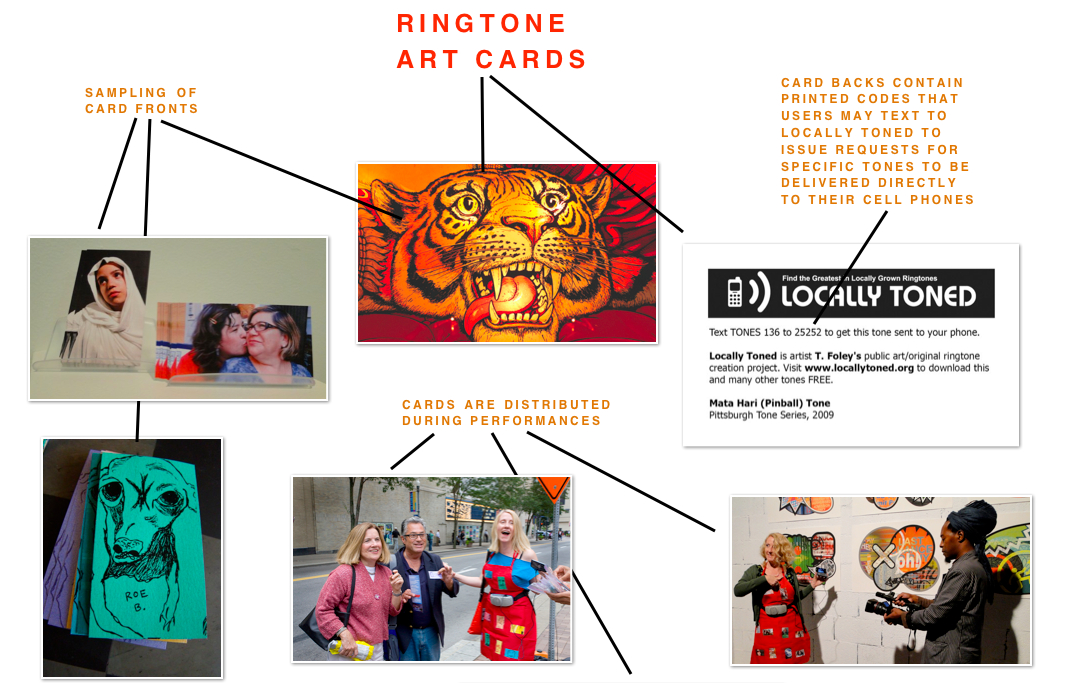
I have a background in media literacy, so I’m interested in people having access to a wide variety of media, and the skills and tools that allow them to produce and analyze media for themselves. Locally Toned democratizes art because it’s produced with others and for others. I’m not an artist working alone in a studio producing ringtones to sell to others. I collaborate with people to turn sounds that are meaningful and/or interesting to them into ringtones. This past weekend I went to the Uniontown Poultry Association’s Fall Show in Fayette County to capture bird sounds with the help of that community. And I collaborate with technologists such as Deeplocal and other artists, Encyclopedia Destructica, to get the tones to the public/onto phones. Deeplocal  built the technology for the project; Encyclopedia Destructica helped me to design distribution techniques (the ringtone art cards). Unlike paintings or sculptures for sale in a gallery, which many people can’t afford, people may own and share these works free-of-charge.

An example of the ringtone art cards

As conceptual artist Robert Smithson expressed in a 1972 essay entitled “Cultural Confinement,” for Artforum, some works of art, when placed in galleries, loose their charge. Locally Toned is that type of work--one may listen to the tones online, but the real audience for the project exists anywhere a user who’s downloaded the tones receives a call on his/her cell phone. The work performs itself at unexpected times and in unexpected places, outside traditional art spaces (galleries and museums).

My boyfriend likes to say that Locally Toned gives people a “sneak-attack” ability. When some of the more unusual tones go off in public, it creates a little scene. For example, the LRAD tone went off one day on my phone at Deeplocal. The CEO assumed it was a fire alarm and told everyone in to exit the building. I let them know it was a false alarm--I was just testing out the sonic canon ringtone.

The tones function as conversation starters. I often use tones from the Bayernhof Museum. When they go off in public, strangers ask me to identify the sounds. Then I tell them about the nearby museum for mechanical musical instruments. The conversation is usually short, but there’s an unexpected exchange that occurs as a result of the tones.

Ringtones are an invention of modern technology, what drew you to use them as a medium? Is there a benefit to using ringtones in your work as opposed to other technologies?

I had always wanted to make ringtones for my phone, and a “call for artists” from Deeplocal inspired me to develop this project. I was also motivated by a strong dislike for music industry and pre-installed ringtones on cell phones--I wanted to make tones that were more interesting or beautiful. Then I became curious about what other people would do if they had the opportunity to make ringtones. And with my media literacy background, I wanted to model that it’s possible to make and share homegrown ringtones.

I use technology to connect and share with others--recording equipment to make the tones, photography to document the sounds, the Web site to distribute the ringtones, and the Blog to promote the stories behind the sounds that are created. Technology helps to extend my work and ideas out into the world. I like what Lawrence Lessig says about on- and off-line sharing economies in his book Remix (http://remix.lessig.org/).

“Gifts in particular, and the sharing economy in general, are thus devices for building connections with people. They establish relationships and draw upon those relationships. They are the glue of community.”

Locally Toned is public art through service to the community—a series of production, promotion and distribution interactions between the public and myself. New social interaction spaces (physical and cyber) are developed around the making and sharing of these tiny aural documentaries, or soundscape snippets. The tones serve as audio identifiers for members of various communities. A person might identify as a cyclist and download Erok's Bicycle Bell Tone for use on his/her phone. The tones are also plotted on a ringtone map.

Do you see your work moving into other technologies in the future? If so, are there any technologies in particular you would like to explore?

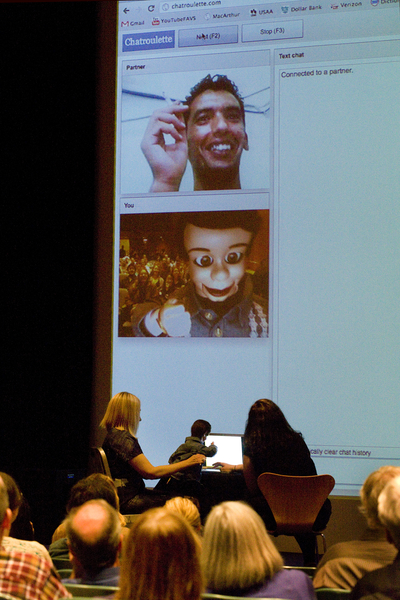
I like to exploit tools that are easy for people to access and use. Recently I’ve created a live and online performance work with Hector, a shy ventriloquist dummy. In The Dummy Is Present, my re-interpretation of Marina Abramović’s The Artist Is Present, 2010, Hector appears on Chatroulette with an audience behind him. The audience appears in the work as spectators and as part of the show. People may sit behind us passively, watching Hector interact with others online (my computer is projected onto a big screen during the performance), or they may become part of the interaction. Some of the people we encounter online say, “Is this for real?!” Audience members respond by shouting or waving a hello, and they may applaud if the other party on Chatroulette performs for us. The performance has been described as voyeuristic, riveting, and magical--it’s all those things and more. I made the work because I wanted to draw attention to contemporary notions of public and private space, and to consider what it means to have an online presence. The Dummy Is Present is part of a larger body of work, Easy Pieces, a series of live and recorded performances featuring a ventriloquist dummy and myself. I’d like to find an interesting application for Twitter within the larger project, but I haven’t figured that out yet.

With Locally Toned and the work with Hector, I use a particular technology so that I may say something about our experiences with it. And I enjoy making work that evolves and changes over time. With both projects, I never know what’s going to happen next--and that’s really fun for me.

The Dummy Is Present - Photo by Larry Rippel

Do you think Locally Toned will ever reach a conclusion?

Locally Toned is an ongoing project. I’m not a Web developer, but I want to be a good shepherd of the project’s technology so that the archive will remain accessible to the public and so that I may add to the collection for years to come. I’m presently seeking funding to make improvements to the Web site, and to release all the tones in the iPhone format. Within the next year, I’d like to identify other cities to collaborate with. The tones are licensed under the Creative Commons Attribution-NonCommercial-Share Alike code, and they show up on other folks’ Blogs. It’s great to see people point back to Locally Toned, and see them re-tell stories about the origins of the sounds.

Ms. Foley is also looking for some Pittsburgh local help with her next project,

Who wants to make a ringtone? This month, I will receive a grant from The Fine Foundation to create a new series of tones from the Pittsburgh region. I’m looking for collaborators. People can contact me by email: locallytoned@gmail.com.

And if you thought her Chatroullete dummy performance sounded cool, Pittsburgh has another opportunity to see it live:

The next performance of The Dummy Is Present will take place at The Warhol Museum on the evening of January 6, 2012. More info can be found at the Ventwittoquisms Tumblr.

---

So what are you waiting for? Go customize your phone with some art!

IBM: A Century of Avant-Garde Thinking

If asked whether data can be beautiful, many of us in the art world would give the questioner a quizzical look. We would then proceed to answer along the lines of “In the art world, we do not ponder over the beauty of data.” But if we were to pose the same question to IBM, they would nod affirmatively. And it bodes well for us to listen to those at IBM because after a century of trial and error, they have agreed to share some of the reasons behind why data is not only beautiful, but also powerful and astonishing. In celebration of a century of avant-garde thinking, the aptly named IBM THINK exhibit is on display at the Lincoln Center in New York. One of the most striking displays is found at the entrance itself; an incredibly beautiful, 123 foot, digital data wall that “visualizes, in real time, the live data streaming from the systems surrounding the exhibit, from traffic on Broadway, to solar energy, to air quality.”

The IBM Think exhibit is on display at the Lincoln Center in New York until October 23

Once inside the exhibit, which is a veritable visual feast, visitors watch a 12 minute film about “awe inspiring stories of the past and the present”; in essence visitors learn about how the advancements made at IBM have shaped the technological course of the 20th century and the opportunities that lie for “making our world better, today.”

The exhibit concludes with an interactive experience, where visitors can delve into the collective knowledge of the scientific and tech world, from “clocks and scales to microscopes and telescopes, RFID chips and biomedical sensors”, on 40 seven foot screens. Through its data visualization techniques and compelling interactive experiences, the IBM THINK exhibit achieves a rare balance between data analysis and beauty.

http://www.youtube.com/watch?v=JVrXAsYd1Wk

But the overall theme of the exhibit is not limited to the dissemination of data, rather it poses a grandiose and rather formidable question; how do we use the breakthroughs in the fields of science, technology, and leadership to make the planet a smarter place? So while the BMW Guggenheim Lab experimented with making metropolises better, IBM’s sets its sights on the well-being of the entire world. Is that an audacious quest? Not quite, because if IBM were a person, they would have on their resume, a century of experience in changing the world, written under qualifications.

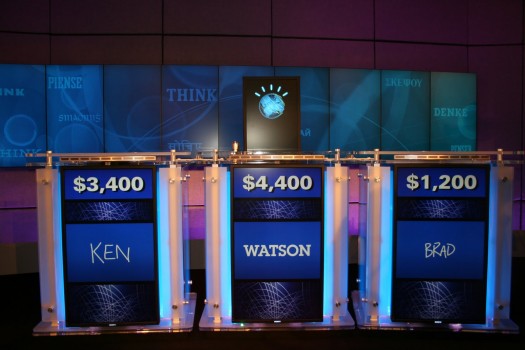
In fact, not only has IBM propelled the world into the 21st century, it continues to build up storms in the ever restive sea of our scientific and technological present. For instance, it’s hard to ignore Watson, the IBM self–contained computer system that proves that computers too are capable of placing themselves in jeopardy.  This is because Watson can process natural language and hypothesize between answers, until it arrives at the right answer through weighing different algorithms and determining its confidence level. And Dr. David Ferrucci, the Principal Investigator for the Watson project, is convinced that computer has potential to transform industries such as business and health care.

Let’s also take a look at a technology that may not have created a storm, but perhaps ripples in the much smaller lake of the art world. Earlier this summer, IBM helped the Metropolitan Museum of Art make quantum leaps in art preservation when it installed wireless environmental sensors called Low-Power Motes. These sensors will help the Met monitor the micro-environment through real-time 3D data that will “measure temperature, humidity, air flow, contamination levels, door positions, light levels, and more.” The sensors will help the museum scientists develop correlation models between environmental conditions and the reactions they have on works of art, eventually leading to better models for art preservation.

So in the end, let’s not move forward but backwards. Let’s rewind our clocks back to the year 1911, when IBM’s successor the Computing Tabulating Recording Corporation sold products such as employee time keeping systems, punched card equipment, and of all things, automatic meat slicers! Compare meat slicers to Watson or Low-Power Motes and we can begin to appreciate the beauty of data analysis techniques and technological advancements. We can finally begin to nod in unison with IBM.

The Millennial Generation: We’ve got the power

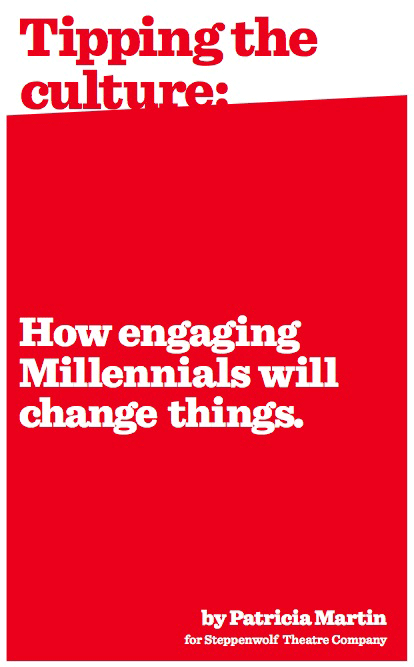
redbookCommissioned by the Steppenwolf Theatre Company, author and culture analyst Patricia Martin recently published the report “Tipping the culture: How engaging Millennials will change things.”Her extensive research on marketing to the generation “eclipsing Boomers and GenX” boils down to the following: the Millennials, those between the ages of 15 and 31, are more networked than any other generation and thus have the power to influence and determine the success and future of an organization. Between blogs, Facebook, MySpace, Twitter and smart phone applications, the Millennials are here, there, everywhere, with everyone, and telling you about it. Because of this, if you can catch them and grab their attention, they will market your product for you. But this is not news. The folks here at Technology in the Arts have offered compelling reasons beyond the obvious (marketing advantages) why not-for-profit arts organizations should tap into these viral networks.

Martin takes a look at the big guys, companies like Google, Ford Motors, and J. Crew, to uncover how they successfully snagged the Millennials. How has J. Crew managed to attract and maintain the 22 to 30 year old Millennials? How did Starbucks gain such a loyal following of 15 to 30 year olds? What techniques are these large, for-profit firms using to advance their brand and secure their position in the future marketplace? Using these case studies, Martin provides insight on marketing to this powerful group of young-adults, divulging what attracts them, how to include them, what they are thinking, what they want and how to engage them.

In her easy-to-digest exposé, Martin sheds light on a generation that seeks to both create and consumer content; a generation that is less interested in sitting passively in the audience than being engaged and having their input heard in the creation of the production. Martin offers the not-for-profit arts sector strategies for effective marketing to Millennials through personalized and engaging social media interactions.

So how do Starbucks and J. Crew do it?

1) Making Millennials the priority, then the brand

2) Increasing the firm’s emotional and lifestyle appeal

3) Creating a sense of belonging for customers through participation

What exactly does this mean to a not-for-profit?

Millennials crave connection, whether through broad networks and communities or through exclusive access to content that creates a sense of intimacy.

Translation: Open your backroom doors by posting video footage to Facebook of a “Day-in-the-life” of your museum director, reveal your “behind-the-scenes” preparations for an upcoming exhibition through Facebook status updates and photo uploads, or tweet from back-stage actors’ excitement moments before the opening act. For those of you theater connoisseurs, break the “fourth wall” to show Millennials you understand their desire for access to content and knowledge. Give Millennials the opportunity, through social media, to discover on their own what you are about. Martin describes this as an “egalitarian social model,” where you (the not-for-profit) and the Millennial become connected as friends and collaborators.

Once you have established a relationship with your users online, your work is only half complete. If you encourage participation online, be sure to reinforce your commitment to the Millennials and their contributions on-site by referencing user generated content in your play-bills, gallery maps, and museum guides.

There is a reason why the Broadway musical Rent and primetime TV shows such as CSI and Gossip Girl have gained momentum among Millennials: they are emotionawhatdotheywantlly charged and engage Millennials in meaningful ways. Creating meaning for Millennials in your not-for-profit could begin with a blog. This forum allows for informal discussion, emotional content, and most importantly, participation. Have your blogger pose questions of substance that encourage meaningful and emotional responses in reaction to a performance or exhibit, such as “Do you agree?”, “What do you think?”, “Tell us how you feel” or “Which character did you relate to most?” By giving Millennials the unadulterated freedom to share their perspective and voice in a dynamic forum, they will have a more personalized experience with your organization.

Fulfilling the emotional desire of Millennials to be connected, heard, and have meaningful experiences will increase the retention rates for this generation in your organization. It does not require the marketing budget or quarterly revenue of J. Crew or Pepsi, just greater attention to the entire customer experience of your cultural brand (think witty videos for downloading, thought-provoking quotes for Millennials to tweet and a survey to remind them they have a stake in your future).

To the Millennials out there, what social media and technological marketing strategies have won you over? And to the not-for-profit arts organizations, how do you use technology and social media to effectively connect with them?

Faster Than Sound: Pushing The Boundaries of Contemporary Music

While conducting the first round of research for my white paper on online audience development, I stumbled across an exciting development in the world of music. I was first introduced to the genre of contemporary music when I noticed the growing trend of string players and, what sounded like, a classical music influence in many popular indie rock bands. Even though I have background primarily in jazz, both classical and jazz worlds share the same audience development woes. It was both promising and exciting to hear so many young musicians take classical music to new territory. Upon further exploration and research, I discovered that the work of many of these musicians and composers is being labeled as 'contemporary' or 'modern' music.While it can be tricky (and at times unfair!) to attach a definite label to these types of projects, it's important to recognize this growing movement, especially as it pertains to the intersection of arts and technology. Faster Than Sound is yet another great example of this type of project. Faster Than Sound, produced by the UK based Aldeburgh Music, is an experimental and cutting edge series that blurs the boundaries of classical and electronic music. There is a strong emphasis on commissioning new works, artists participating in residencies and innovative collaborations. There is also an emphasis on emerging technology, and all of the artists involved share a common goal of embarking on new musical adventures together.

Earlier this month, composer and visual artist, Christian Marclay, came to the series to develop a specially commissioned work entitled, Everyday. For this endeavor, Marclay collaborated with other musicians including Steve Beresford, John Butcher, Mark Sanders and Alan Tomlinson. Their ensemble also worked with a local marching band and employed the use of turntables. The work was not just limited to music, however. Everyday also combined found film footage sampled from old movies.

The next event in the series, Fall Back will feature a specially commissioned new work that will be created during a week long Aldeburgh Residency. The work will premiere on Saturday, Octover 29 at 8 pm. British dubstep artist, Roly Porter, will be joined by Cynthia Miller for a very special collaboration. The improvisation between these prolific exponents in one of the oldest and one of the newest forms of electronic music is sure to push genre boundaries, and create a truly unique musical experience. The music will be partnered by Rod Maclachlan's epic archaic visual projections.

For a small taste of what the series is like, check out the video above, and visit their Youtube channel! And stay tuned for a special podcast featuring some of the participating artists and creative director.

Who Should Do It? Dealing with the Division of Labor

VolunteerHub LogoThe following is a guest post from VolunteerHub.com writer Shawn Kendrick. VolunteerHub is a leading cloud-based software that streamlines volunteer management. For two decades, VolunteerHub has been trusted by volunteer coordinators throughout the world. With over 1 million event registrations managed, VolunteerHub simplifies the scheduling, registration, and tracking of volunteers.  VolunteerHub is a product of Carr Engineering, Inc. Learn more about VolunteerHub >> Deciding on the division of work within a department can be difficult. You have to take care to make sure everyone is challenged but not overburdened. No matter how hard you try, it can be hard to get it just right. Some workers will always feel they carry more than their fair share of the load. Others think that you didn’t give them enough duties because you don’t value their expertise and may even become bored or complacent. When you add volunteer considerations to the mix, you’ve got even more to think about. Below we discuss some perspectives to consider when deciding who does what.

Think Public Relations First

Your first thought in assigning any duties should be about what kind of image you will be putting out to those your serve and to the general public. If the job you are assigning has a great deal of public relations involved, it’s probably best to have your paid staff perform the function. You don’t want the general public to think you have all your non-paid folks doing the work while your actual employees hang out in the back office. Of course, we know behind-the-scenes work is as difficult and important as customer-facing tasks, but people want to know who/what their taxes/donations are going toward. It’s more tangible to them if they actually interact with the paid staff.

Look at Dollars and Cents

Now that we’ve got your organization’s image covered, we will want to look at matters from a monetary standpoint. Nonprofits, of course, have to consider dollars and cents when making decisions, just as for-profit businesses do. In general, you’ll want to look at the labor costs and attempt to sink as little of these costs as possible. For example, you have a project that requires ten hours of administrative time and then ten more hours to actually execute it. You expect you will earn $40 an hour during the execution phase (a fundraising project, for instance) and nothing during the administration part, effectively making the administrative portion a sunk cost. You have one paid worker at $20 an hour for the project and one volunteer. All things equal, you would want the volunteer to be used for the administrative portion and the paid worker on the execution phase.

What difference does it make? you might be wondering. It’s going to cost us $20 an hour for ten of the hours, and the other ten hours will be free, any way I slice it. Either way I’m investing the same amount of money in the project. The difference is this: by using the volunteer in the earlier phase, you are sinking $0 in the administrative time. If you find out early in the execution phase that you are only making $10 an hour in revenue while paying $20 an hour, you can pull the plug early, thus mitigating your losses.

Don’t Forget about the Volunteer’s Perspective

Of course, the above examples are very cut and dry. In the real world, if you strictly offer menial work to your volunteers, many won’t stick around long. So, if you have a volunteer who is great with people and doesn’t want to hide behind a desk, get him or her out there in front of folks. Same goes for volunteer recruitment: it makes the most sense to get happy volunteers to recruit other potential candidates. Just be sure to check with your volunteers often to gauge their preferences. Some will encourage you to take advantage of their expertise and skill set, while others would rather contribute in a less taxing way. Use these preferences, along with your staff’s, to decide who will shine on a particular job or project.

Ultimately, it’s up to the volunteer coordinator to know your employees’ and your volunteers’ strengths and weaknesses, as well as the nuances of your situation. When this is combined with the factors mentioned above, you’ll find task assignments to be both easier and more fruitful for your organization.